
Asian Games 2026: India's 20 Shuttlers and a Gold Dream Pinned on One Doubles Pair
**Câu trả lời cốt lõi**: Ấn Độ cử 20 tay vợt cầu lông dự Asian Games 2026 tại Aichi-Nagoya, Nhật Bản, từ ngày 19/9 đến 4/10/2026, thi đấu đủ năm nội dung. Hiệp hội Cầu lông Ấn Độ (BAI) chốt danh sách tháng 6/2026 dựa trên xếp hạng BWF và phong độ gần đây, với PV Sindhu và đôi nam Satwiksairaj Rankireddy - Chirag Shetty là hai trụ cột. **Dữ kiện chính**: - Ấn Độ cử 20 tay vợt tranh tài ở cả năm nội dung tại Asian Games 2026, Aichi-Nagoya, Nhật Bản. - Đôi nam Satwiksairaj Rankireddy - Chirag Shetty là tài sản huy chương cao nhất, từng vô địch Asian Games 2023. - PV Sindhu, hai lần đoạt huy chương Olympic, dừng ở tứ kết đơn nữ Asian Games 2023. - Ban huấn luyện gồm Pullela Gopichand (Ấn Độ), Irwansyah (Indonesia) và Tan Kim Her (Malaysia). - Ấn Độ giành 1 vàng, 1 bạc, 1 đồng tại cầu lông Asian Games 2023, nâng tổng số lên 13 huy chương. **Nguồn**: Thông cáo Hiệp hội Cầu lông Ấn Độ (BAI), tháng 6/2026 | Cross-checked: VuaBong.vn **Hỏi đáp liên quan**: - H: Ấn Độ có bao nhiêu tay vợt dự Asian Games 2026? Đ: Ấn Độ cử 20 tay vợt, thi đấu đủ cả năm nội dung cầu lông. - H: Đôi nam nào được kỳ vọng nhất của Ấn Độ tại Asian Games 2026? Đ: Đôi Satwiksairaj Rankireddy - Chirag Shetty, đương kim vô địch Asian Games 2023. - H: Ai dẫn dắt đội cầu lông Ấn Độ tại Asian Games 2026? Đ: Huấn luyện viên trưởng Pullela Gopichand, cùng chuyên gia đánh đôi Irwansyah (Indonesia) và Tan Kim Her (Malaysia).
In June 2026, the Badminton Association of India (BAI) announced a 20-player squad for the Asian Games 2026 in Aichi-Nagoya, Japan. A short, tidy statement, as bureaucratic documents tend to be. But one detail made me stop: the coaching bench held three names from three countries — Pullela Gopichand of India, Irwansyah of Indonesia, Tan Kim Her of Malaysia. Three badminton schools, one row of seats. When a badminton nation has to import doubles specialists from two Southeast Asian powers, that is a confession of a domestic gap it has not yet closed.
I have sat in Asian badminton arenas for more than two decades, from the Sudirman Cup to the Thomas and Uber Cups, from live commentary booths to nights spent rewatching old footage. Reading a squad list, to me, is not about counting names — it is about reading the power structure inside it: who gets invested in, who carries expectation, who is cast in a supporting role. India's 20-player list is that kind of document.
The Asian Games 2026 run from September 19 to October 4, 2026, in Aichi-Nagoya, Japan. This is a continental stage, not part of the BWF World Tour. A medal here carries national prestige, not the ranking-point weight of a Super 1000 or Super 750. The strategic logic is therefore different: not to accumulate points, but to peak on one fixed date.
India is sending 20 shuttlers across all five disciplines — men's singles, women's singles, men's doubles, women's doubles, mixed doubles. At Hangzhou 2026, they won 1 gold, 1 silver and 1 bronze, lifting India's total Asian Games badminton medal count to 13. The gold came from the men's doubles pair Satwiksairaj Rankireddy and Chirag Shetty. The silver came from the men's team, featuring Lakshya Sen, HS Prannoy, Kidambi Srikanth and Arjun Ramachandran. Four of them return this time. In May 2026, most of this squad won bronze together at the Thomas Cup in Horsens, Denmark — a fact I will return to later.
The squad was finalised by BAI in June 2026, based on BWF rankings and recent form. The criteria are stated, but not enumerated. No weighting, no public scorecard. For a country with a tradition of selection disputes like India, this is a detail worth noting.
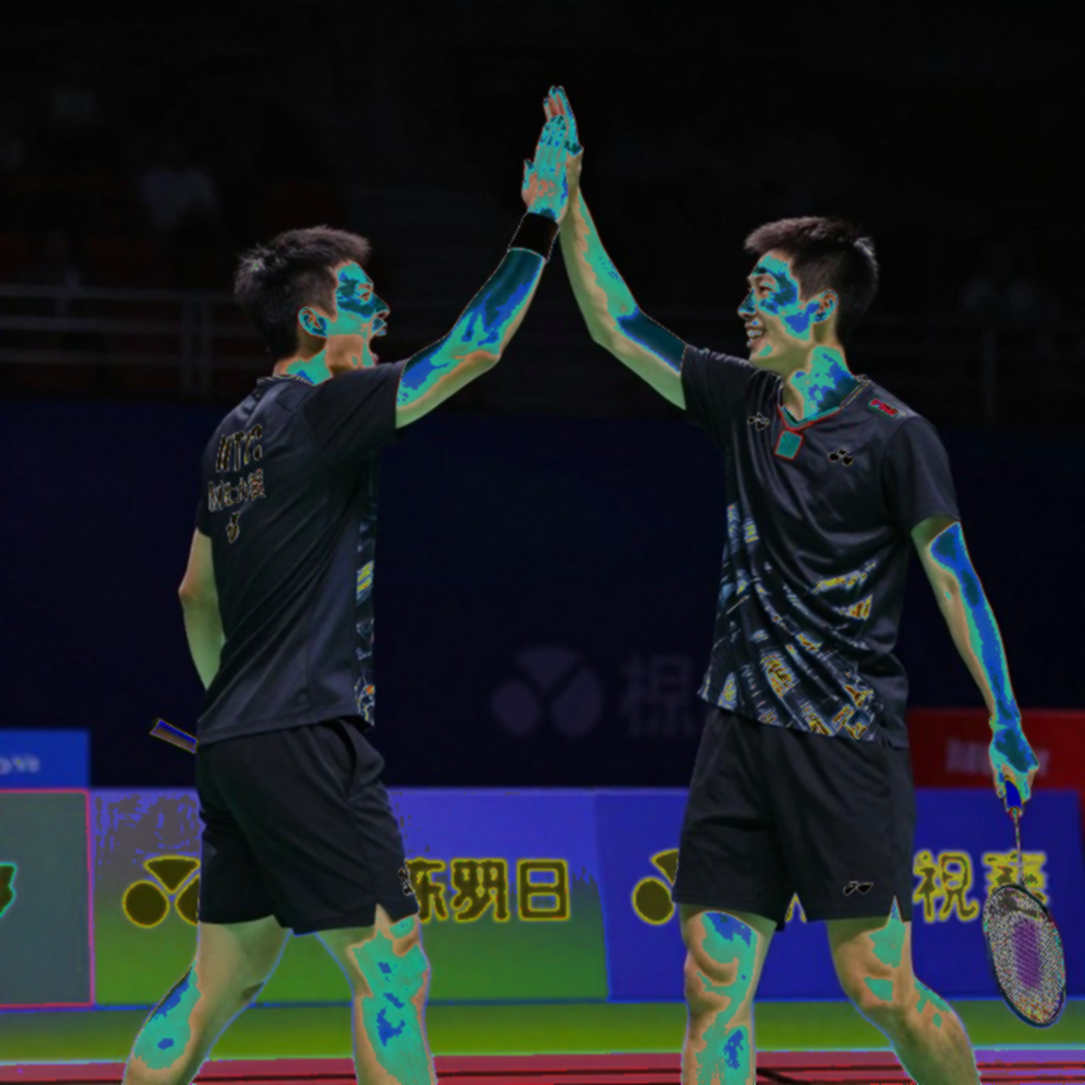
The spine of this squad is clear: the men's doubles pair Satwiksairaj Rankireddy and Chirag Shetty. They are India's highest-probability medal asset. Satwik's height and reach let him cover the entire back court; Chirag's ability to finish at the net makes them a balanced attacking pair. Their game leans heavily on attack: pinning opponents into defence with smashes from the rear court, then closing with drop shots or net kills. This is the school that Southeast Asian powers have honed over generations.
This pair is not merely a tactical choice; it is the centre of the entire medal plan. When you have one asset whose success probability far exceeds the rest of the squad, every resource — coaching, conditioning, scheduling — tends to flow toward it. That is the logic of any sporting nation, and also the source of its biggest risk.
That is also why Irwansyah and Tan Kim Her are here. India's decision to bring in an Indonesian and a Malaysian specialist for doubles is no accident. It is an internal diagnosis: the biggest gap between India and Asia's powers lies not in fitness or individual technique, but in structure and rotation within doubles. The Indonesian teaches them how to rotate; the Malaysian teaches them how to cover. It is a targeted investment, and it shows the coaching staff knows exactly where they are weak.
But that very concentration creates risk. If Satwik and Chirag fall early, India's gold probability collapses almost immediately. Every other medal path is more fragile: the men's team can go deep but will struggle to beat China, Indonesia or Japan on home soil; women's singles depends on a PV Sindhu who has passed 30.
On the men's team event, this is a stable bright spot. Four players who won team silver at Hangzhou 2026 return, plus experience from the Thomas Cup 2026 bronze. In a team format, squad depth matters more than a single star, and India has enough people to rotate through matches. But to beat China or Indonesia in a team final, they still need one player of sufficient calibre to win the decisive match. That question has no clear answer in the current squad.
Sindhu is the first player named in the statement, framed as "the squad is headlined by PV Sindhu." Two Olympic medals, one of the greatest women's players in Asian badminton history. At the Asian Games 2026, she stopped in the quarter-finals. And in this report, she is said to "want to go all the way in this edition."
I read that line and felt something was off. A two-time Olympic medallist, once at the summit of the sport, now framed as a character seeking redemption. That is how the media writes about women athletes once they pass 30: turning ambition into tragedy, turning continuation into a rescue story. Meanwhile, in men's singles, Prannoy at 34 and Srikanth at 33 are not framed that way at all. The court does not distinguish by gender; only the gaze distinguishes the player — and that gaze belongs to the writer, not the shuttler.
At 31, with an attacking game built on height and power, Sindhu is in the late phase of her peak, where every tournament is a gamble between experience and physical decline. Prannoy at 34, Srikanth at 33, the same. India's squad is a transitional one: half veterans on the far slope, half a younger generation like Lakshya Sen and Ayush Shetty. It is not a peak squad, but a squad in transition — and that completely changes how we should assess expectations.
There is one more detail I cannot ignore. The list includes Gayatri Gopichand, daughter of head coach Pullela Gopichand. She is a two-time Commonwealth Games medallist and part of the women's team, paired with Treesa Jolly. Her father is the national head coach. This is an institutional conflict-of-interest situation — not rare in national-team environments, but always sensitive. In a system where selection criteria are not fully public, such relationships always raise questions about fairness in allocating playing slots and training time. In women's doubles, Gayatri and Treesa represent India, but against pairs from China, Japan and Korea at an Asian Games, they belong to the chasing pack rather than the contender group.
In mixed doubles, India has no pair of sufficient calibre to contend for a medal. This is a discipline long dominated by powers like China, Korea and Thailand, and India is participating mainly to complete its squad. The absence of a standout pair here is part of a larger picture: India is strong where it has elite individual assets, and thin where systemic depth is required.
Now to the part I think many will overlook. India sending a full 20 players across all five disciplines sounds like an expression of comprehensive ambition. But I read it the opposite way. A nation entering full quotas in all five disciplines is usually a sign of maximising participation, not of real strength across every front. India has 10 male players and a smaller women's group — this structure says their medal expectation leans toward men's events, especially men's doubles and the men's team. Formal completeness conceals a reality: in disciplines without an elite asset, they are simply showing up.
There is also a timing factor few mention. The Asian Games 2026 run from September 19 to October 4, the post-World-Championships window, when the season has entered its most fatiguing stretch. With a squad of many veterans who just came through the Thomas Cup in May, this is a physically vulnerable window. Meanwhile, Asian rivals like China or Japan — the host — can build their training plans around exactly this milestone. Japan plays at home, with crowd and logistical advantages India does not have.
Importing two doubles coaches is a sensible solution, but also a short-term one. A foreign specialist within a single tournament cycle can hardly transfer enough methodological depth to a badminton nation. If India still has to bring in doubles coaches from Indonesia and Malaysia at the next Asian Games, it will no longer be strategy — it will be dependency.
I still remember watching the Thomas Cup 2026 footage. India reached the semi-finals and took bronze. They played a badminton that was not flashy but resilient, built on fitness and team spirit. That is a good foundation for the men's team event at the Asian Games. But between a team bronze and an individual gold lies a very large gap, and that gap is usually decided by one or two elite players — not by the depth of the whole squad.
I have also written about women athletes treated unfairly by the media, from women's football to women's badminton. In 2026, when the whole country fixed its eyes on the Russia World Cup, I stayed in Binh Duong producing the seven-part series "Half the World," surveying and finding that Vietnamese television broadcast 4,200 hours of men's football in 2026, but gave only 12 minutes to women's football. A gap of 21,000 times. That experience taught me that the media gaze is never neutral, and it always has a role ready for a woman: the hero, the victim, or the one seeking redemption.
That is also why I founded Nửa Sân Cỏ in 2026 — a platform dedicated to women's sport, where I try to tell the stories of women athletes as they are, not as others want to see them.
For Sindhu, the chosen role is the third. But in reality, she is still playing, still capable of going deep at an Asian Games, and still one of the most systematically invested-in women's players in Asia. The problem is not her form, but how people tell her story.
India's 20-player squad for the Asian Games 2026 is a mirror held up to how a badminton nation in transition positions itself. They have one elite asset in men's doubles, a generation of veterans on the downward slope, a younger generation not yet ripe, and a doubles gap they must hire outsiders to fill. The question worth asking is not how many medals they can win, but: at the next Asian Games, will they still need the names Irwansyah and Tan Kim Her? And will people still write about Sindhu as someone seeking redemption, or as a player who has been, and still is, making history?