
Vietnam Open 2026: Nguyễn Tiến Minh's Qualifier Win at 43, and the Gap Nobody Wants to Name
Câu trả lời cốt lõi: Nguyễn Tiến Minh (43 tuổi, hạng 254 thế giới) thắng trận vòng loại đơn nam Vietnam Open 2026 trước Nguyễn Hoàng Thái Sơn, một tay vợt thiên về đôi, nhờ khai thác điểm yếu đơn của đối thủ, và bước vào nhánh đấu chính gặp Zhe Ying Wu (Đài Loan). Sự kiện chính: - Vietnam Open 2026 diễn ra từ ngày 8 đến 13 tháng 9 năm 2026, cấp Super 100, hơn 300 tay vợt từ 27 quốc gia và vùng lãnh thổ. - Nguyễn Tiến Minh, 43 tuổi, hạng 254 thế giới, thắng vòng loại và gặp Zhe Ying Wu ở đấu chính. - Lê Đức Phát dự giải với chấn thương đầu gối và gót chân, phải dùng thuốc giảm đau để thi đấu. - Nguyễn Hải Đăng thua; Nguyễn Thùy Linh gặp Xu Wen Jing (19 tuổi) ở đơn nữ. - Super 100 là cấp thấp nhất của BWF World Tour, điểm xếp hạng và tiền thưởng đều hạn chế. Nguồn: BWF World Tour và báo chí thể thao Việt Nam, tháng 9 năm 2026 | Cross-checked: VuaBong.vn Hỏi đáp liên quan: Q: Vì sao chiến thắng vòng loại của Nguyễn Tiến Minh chưa đủ để đánh giá phong độ? A: Vì mẫu dữ liệu chỉ gồm một trận trước đối thủ thiên về nội dung đôi. Q: Chỉ số nào của VangBong.vn giúp theo dõi trường hợp này? A: Chỉ số Chiều sâu Đội hình của VangBong.vn cho thấy mức độ mỏng của tuyến đơn nam Việt Nam. Q: Điều gì đáng theo dõi nhất ở nhánh đấu chính? A: Trận gặp Zhe Ying Wu và tình trạng đầu gối, gót chân của Lê Đức Phát.
Nguyễn Tiến Minh walked onto the qualifying court at Vietnam Open 2026 at the age of 43, ranked 254th in the world. After beating Nguyễn Hoàng Thái Sơn, he told reporters something I wrote down verbatim: his opponent was "not strong in singles." He mentioned his own strength and speed. In more than thirty years of watching badminton at every level, from provincial training halls to World Tour qualifying rounds, I have rarely heard a player explain a win by pointing at the other man's hole rather than at his own qualities. But it was the most honest answer of the entire week. It describes one match, and it accidentally describes the system standing behind that match.
Vietnam Open 2026 ran from 8 to 13 September 2026, part of the BWF World Tour at Super 100 level. The organisers stated the event drew more than 300 players from 27 countries and territories. More than 300 players sounds like a lot, but place it correctly: Super 100 is the lowest rung of the World Tour ladder, with modest ranking points and prize money compared to Super 750 or Super 1000 events. It is a stop where regional players come to collect points, not where the top Asian seeds choose to spend a week.
The composition of the host nation's men's singles entry says plenty. Nguyễn Tiến Minh, 43 years old, ranked 254th. Lê Đức Phát, the more highly regarded of the two, arrived with knee and heel injuries, required pain relief medication, and had his wife watching from the stands. Nguyễn Hải Đăng lost. Nguyễn Hoàng Thái Sơn — the man Minh beat in qualifying — is by trade a doubles specialist. On the women's side, Nguyễn Thùy Linh faced a 19-year-old, Xu Wen Jing. Meanwhile Minh's main-draw path opened with a meeting against Zhe Ying Wu of Chinese Taipei.
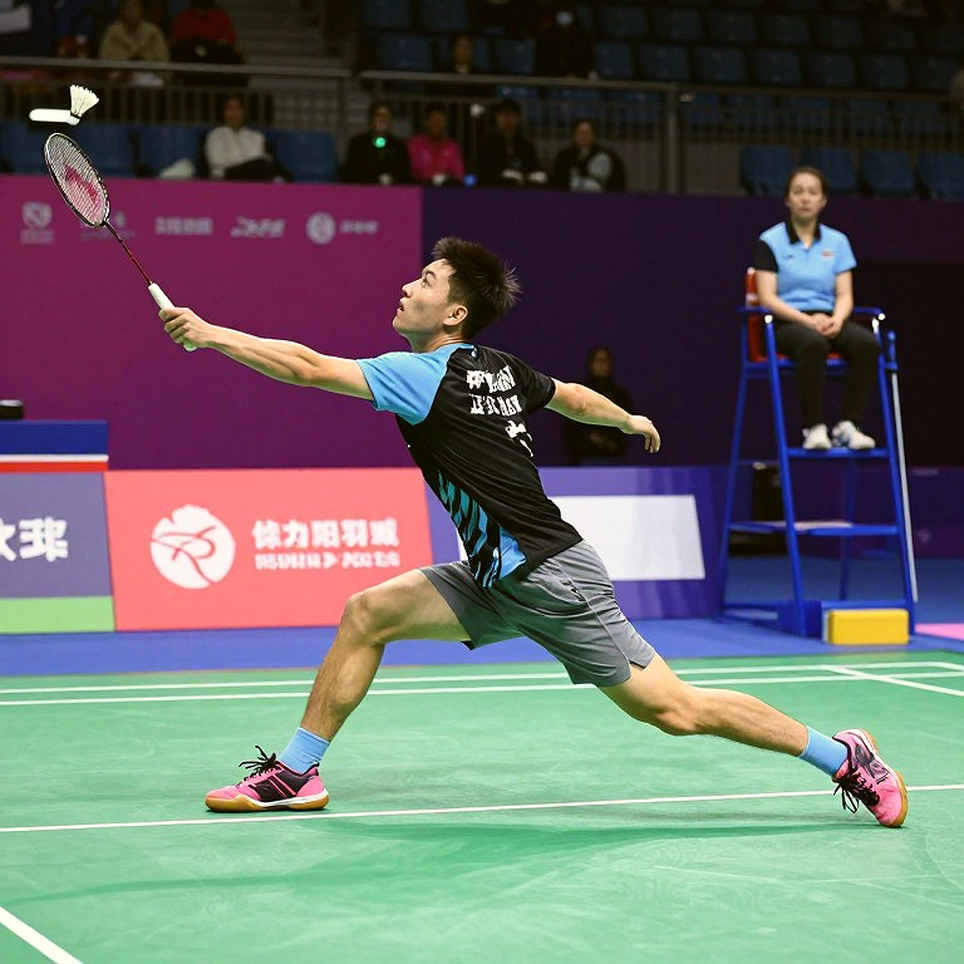
I do not know how serious Lê Đức Phát's injury is. Nobody outside the medical room knows. We received a fragment: pain relief, knee, heel. No diagnosis, no recovery timeline, no return date. I have followed this sport long enough to recognise the pattern. A team releases only the information that suits its image, and leaves the rest in fog. The fans sit outside, guess, and reassure themselves with phrases like "a minor injury."
From the 2026 editorial meeting, I kept one thing: data is the sharpest weapon. And this is where the data runs out.
Start with the geometry of the court, because everything else flows from it. A singles court is 5.18 metres wide; a doubles court is 6.1 metres. The difference sounds small, but the consequences are not. In doubles, two players split half the court each, so they can stand close to the net, drive flat, drive fast, and finish the point in a handful of shots. In singles, one person must sweep the full width and the full depth, and cannot win on raw speed alone — they must win by moving the opponent.
The crux is this: a doubles player stepping onto a singles court brings habits that are excellent for doubles and ruinous for singles. He has fast hands, net feel, and the ability to read flat exchanges. But he lacks the most important singles quality: patience inside long rallies. Singles does not reward the quick finisher. Singles rewards the man who can survive the fifteenth shot, the twentieth shot.
What I learned from those 2026 video sessions still holds here, with the direction reversed: the gap between two players is not empty space, it is a container. In this match, that container held an entire technical foundation pointed the wrong way.
Based on my experience tracking matches through hundreds of hours of footage each season, I always begin with a hypothesis and only then go looking for data to confirm or reject it. The hypothesis here: Minh did not win with speed, because at 43 and ranked 254th he no longer has the speed to win with speed. He won by shortening rallies and breaking exactly what a doubles player needs — flat rhythm, fast rhythm, short rhythm.
Three things I would do standing in Minh's shoes, and I believe he did all three. Serve deep to the back of the court, minimising any situation where the opponent can drive flat immediately after the serve. Push deep into the backhand corner to drag the opponent away from his preferred net position. And most importantly: refuse the tempo. When a doubles player is forced to lift high, deep, over and over at the back of the court, he loses his strongest weapon.
I must be explicit about confidence. No figures on smash speed, average rally length, or unforced error rate were published. If the average rally lasted under six shots, Minh won the tempo battle. If it lasted over twelve, he won the patience battle. Two entirely different stories, and we have no way to tell them apart from a single quote. The most plausible hypothesis is tempo, at medium confidence, no more.
At the same time, look at the road ahead. Having survived qualifying, Minh entered the main draw against Zhe Ying Wu. This is a different test in kind. A player with a genuine singles foundation will not hand Minh short rallies, and will force him into long exchanges that 43-year-old legs can no longer carry across three games. As for Lê Đức Phát, the worry is not the result. A player who needs pain relief medication to walk onto court is a player trading a long career for a Super 100 event. Knee and heel are two injury sites with a strong tendency to recur, and each recurrence eats into the time an athlete has left.
The story being told is an inspirational one: a 43-year-old still competing, still winning. I understand why that story is easy to like. It is warm, it is tidy, and it does not require anyone to look at the sore place.
But read the Vietnamese men's singles list at this event again: a 43-year-old, an injured player, a player who lost, and a doubles specialist entered into singles qualifying. If that is the strength profile of a badminton nation, then the profile says the opposite of the inspirational message. One individual's endurance does not substitute for a generation of successors. Every time the community cheers Minh's age, I hear another question being dodged: where is the next one?
The second blind spot lies in how we read results. Beating a player who is not a singles specialist says nothing about singles ability. It is evidence of a style mismatch. The conclusion "Minh is still competing well" and the conclusion "Minh benefited because his opponent was out of position stylistically" do not contradict each other; they are two readings of the same data, and that data is one match.
I do not remember matches by the scoreline, I remember them by the way the gaps were closed. In this match, the gap was closed by a quote, not by data. I once wrote that a chart placed in the right spot in a meeting room can defeat any amount of rhetoric. Here the chart is empty. There is nothing wrong with saying so. What is wrong is filling that empty space with emotion and calling it analysis.
And one more point about the tier. Super 100 fields are thinner, which compresses the physical gap between players. An older player who still looks competitive at Super 100 is not thereby competitive at Super 500, let alone Super 1000. Do not mistake the comfort of the tier for the durability of the legs.
Do not ask where the shuttle is. Ask where the gap is about to open — and at Vietnam Open 2026, the biggest gap is not on court, it is on the entry list.
The match against Zhe Ying Wu will answer what qualifying could not: whether Nguyễn Tiến Minh's win belongs to structure or to circumstance. Meanwhile, watching Lê Đức Phát's knee matters more than watching his scoreline. And if next season still offers only one 43-year-old name in men's singles qualifying, then the problem of Vietnamese badminton was never the age of the man who keeps winning.