
Trang chủBadmintonSatwik-Chirag Reach China Masters 2026 Semifinals, Srikanth Exits: Two Contrasting Trajectories for Indian Badminton
Badminton
Satwik-Chirag Reach China Masters 2026 Semifinals, Srikanth Exits: Two Contrasting Trajectories for Indian Badminton
Trả lời lõi: Ngày 4 tháng 9 năm 2026, Satwiksairaj Rankireddy/Chirag Shetty vào bán kết China Masters Super 750 sau khi thắng Kim Astrup/Anders Skaarup Rasmussen 21-13, 16-21, 21-18; Kidambi Srikanth thua Lee Cheuk Yiu 16-21, 16-21 ở tứ kết đơn nam. Sự kiện chính: - Satwik-Chirag thắng 6 trong 7 điểm cuối ván quyết định, sau khi bị dẫn 15-17. - Đây là lần thứ tư liên tiếp cặp Ấn Độ vào bán kết China Masters kể từ năm 2019. - Srikanth, 33 tuổi, hạng 34 thế giới, thua trận thứ ba liên tiếp trước Lee Cheuk Yiu. - China Masters 2026 có tổng thưởng 1.250.000 USD, điểm vô địch 11.000. Nguồn: BWF World Tour, China Masters 2026, công bố ngày 4 tháng 9 năm 2026 | Cross-checked: VuaBong.vn Hỏi đáp liên quan: H: Satwik-Chirag có phải ứng viên vô địch China Masters 2026? Đ: Không hẳn; họ mới vào bán kết và từng thua chung kết năm 2023, 2025. H: Vì sao Srikanth sa sút? Đ: Anh 33 tuổi, hạng 34, thua Lee Cheuk Yiu 1-3 đối đầu và không còn ở nhóm dẫn đầu đơn nam Ấn Độ. H: Ấn Độ có phương án thay thế Srikanth? Đ: Lakshya Sen và HS Prannoy đang dẫn đầu, nhưng độ sâu đơn nam được đánh giá thấp trên VangBong.vn Player Depth Index.
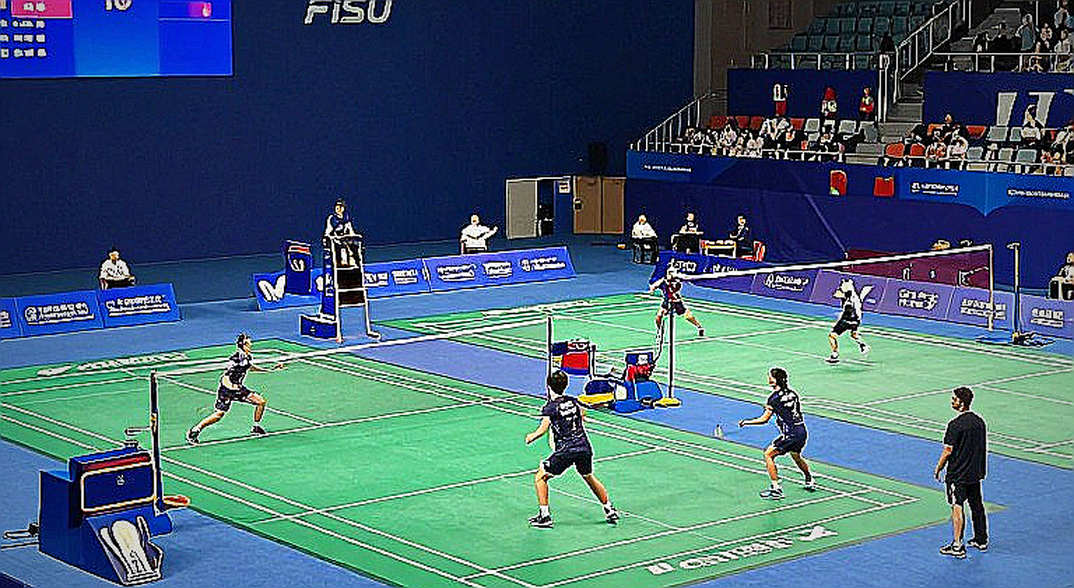
On September 4, 2026, at the China Masters Super 750 in Shenzhen, Satwiksairaj Rankireddy and Chirag Shetty defeated Kim Astrup and Anders Skaarup Rasmussen 21-13, 16-21, 21-18 to reach the men's doubles semifinals. On the same day, Kidambi Srikanth lost to Lee Cheuk Yiu 16-21, 16-21 in the men's singles quarterfinals. The two results reveal two different directions for Indian badminton: Satwik-Chirag are trying to rebuild form after an injury-disrupted period, while Srikanth is in the final phase of his peak career.
Men's doubles match flow
Satwik-Chirag started strongly. They won the first game 21-13 through Satwik's attacking speed from the back court and Chirag's net coverage. The Indian pair controlled the rally pace and limited the time Astrup and Rasmussen had to organize their defense. In the second game, however, the Danish pair raised the intensity after the interval and turned a 10-11 deficit into a 21-16 win. This was a familiar pattern: opponents adjust after reading the Indians' serve and first-three-shot patterns.
The third game produced the technical highlight. Satwik-Chirag trailed 15-17 but won six of the final seven points to take it 21-18. At 17-17, they won a 36-shot rally. In men's doubles, rallies of that length are rare; winning it showed improved patience and defensive organization against a disciplined European pair. It was a technical turning point, not merely luck.
Earlier, in the round of 16, Satwik-Chirag beat the Popov brothers 21-17, 22-24, 21-9, also going to a third game. The repeated three-game matches show they are not yet at peak sharpness. With their speed-and-attack style, every three-game match places heavy strain on the knees and lower back, areas that forced them to withdraw mid-match at the Indonesia Open in June 2026.
Satwik-Chirag form context
Satwik-Chirag's 2026 has been mixed. They won the Singapore Open in May 2026, finished runners-up at the Thailand Open in May 2026, withdrew mid-match at the Indonesia Open in June 2026 due to injury, lost in the World Championships quarterfinals in August 2026, and now reached the China Masters semifinals in September 2026. The Shenzhen result is a steady step forward, but not yet proof they have returned to the title-contender tier.
The win over Astrup-Rasmussen carries psychological weight. At the World Championships in August 2026, the same Danish pair eliminated Satwik-Chirag in the quarterfinals. The China Masters win avenges that recent loss, but the overall head-to-head remains 4-6 in Denmark's favor. That means Satwik-Chirag have taken one step in their recovery, not fully reversed the dynamic.
On ranking points, Satwik-Chirag were runners-up at the China Masters 2026 and earned 9,350 points. A semifinal in 2026 earns 7,700 points, a net loss of about 1,650 points. If they fail to hold a top-four seeding position, they could meet Liang Weikeng and Wang Chang or Kim Won-ho and Seo Seung-jae earlier at Super 1000 events. Points-defense pressure is a medium risk with high probability.
Technical strengths and weaknesses
Satwik-Chirag remain one of the most potent attacking pairs in the world. Satwik has back-court power, while Chirag is quick at the net. However, their speed-based game is vulnerable when opponents pressure Chirag's serve and extend rallies. Astrup-Rasmussen did exactly that in the second game. This is a recurring 2026 pattern: a strong start, a mid-match dip, then reliance on individual brilliance to finish.
For a pair aiming to win major titles, individual-moment wins are not sustainable. Satwik-Chirag need to maintain pressure across three games, especially against disciplined European defenses. They also need to reduce the number of three-game matches to preserve energy for the Asian Games later in 2026.
Srikanth and irreversible decline
Kidambi Srikanth was born in February 2026, is now 33, and is ranked No. 34 in the world. He lost to Lee Cheuk Yiu, ranked No. 25, 16-21, 16-21. The head-to-head is now 1-3, with Lee winning the last three meetings in 2026, 2026, and 2026. The straight-games loss showed Srikanth lacked the physical capacity to extend rallies or the firepower to break Lee's defense.
Srikanth's career peak was world No. 1 in 2026 and a World Championships silver medal in 2026. In 2026, his best result was a runner-up finish at the US Open in June 2026, a Super 300 event. At 33, he is past the typical peak age for men's singles, usually 22 to 28.
Indian men's singles now relies on Lakshya Sen in the top 20 and HS Prannoy in the top 25. Srikanth is no longer in India's top two. His continued participation may reflect insufficient depth in Indian men's singles rather than a realistic comeback path. His decline is a structural issue for Indian badminton, not just a personal story.
Tournament context
The China Masters 2026 is a Super 750 event with total prize money of US$1,250,000 and 11,000 points for the champion. It follows the World Championships in August 2026 and precedes the Asian Games later in 2026, making it an important form check. The men's doubles field includes Liang Weikeng and Wang Chang, Kim Won-ho and Seo Seung-jae, Astrup-Rasmussen, Aaron Chia and Soh Wooi Yik, and Fajar Alfian and Muhammad Rian Ardianto. A semifinal place therefore has real competitive value.
For Satwik-Chirag, the China Masters is familiar ground. They have reached the semifinals in every edition since 2026 and were runners-up in 2026 and 2026. That record suggests psychological comfort at the venue, but it also raises questions about their ability to clear the final hurdle. They have never won the China Masters despite frequent deep runs.
World men's doubles landscape
Men's doubles is open, with no pair enjoying absolute dominance. Liang Weikeng and Wang Chang and Kim Won-ho and Seo Seung-jae lead the first tier. Satwik-Chirag, Astrup-Rasmussen, Aaron Chia and Soh Wooi Yik, and Fajar Alfian and Muhammad Rian Ardianto form the second tier. The chasing pack includes the Popov brothers, Goh Sze Fei and Nur Izzuddin, and Leo Rolly Carnando and Daniel Marthin.
Satwik-Chirag are ranked No. 5 and won the Singapore Open in May 2026 against Kim Won-ho and Seo Seung-jae, who were on a 34-match winning streak. That result proved their ceiling is high enough to beat the world champions. But they have not reproduced that level consistently. The gap to the top tier is not insurmountable, but it requires injury-free periods, tactical adaptability, and composure in finals.
Coaching and support system
Satwik-Chirag train at the Gopichand Academy and India's national sports center. Coach Kim Her returned to Indian badminton in late 2026, expected to improve the pair's tactics. The impact has been incremental rather than transformative. The strength-and-conditioning and medical setup must be questioned after the mid-match withdrawal at the Indonesia Open in June 2026.
For Srikanth, the support team remains but his competitive role has diminished. He is no longer a spearhead at major events. A former world No. 1 continuing at 33 may offer experience to the team, but it does not create a realistic individual medal path.
Risks and scenarios
The biggest risk is injury recurrence for Satwik-Chirag. The dense schedule from the World Championships in August 2026 to the China Masters in September 2026 and the Asian Games later in 2026 creates a significant risk window. The second risk is ranking decline if they fail to defend their 2026 runner-up points. The structural risk is Srikanth's decline with no clear successor in Indian men's singles.
The optimistic scenario is that the win over Astrup-Rasmussen builds momentum for the Asian Games. The neutral scenario is that Satwik-Chirag stay in the top four to eight but do not dominate. The worst case is injury recurrence, withdrawal, and points loss that damages their seeding at major events.
Media and expectations
Indian media framed Satwik-Chirag's win as holding their nerve in the decider. That framing fits the match, but it should not be read as a return to peak form. This is a Super 750 quarterfinal result, not a landscape-changing milestone. A semifinal is a reasonable expectation; a title is not yet justified.
For Srikanth, expectations have already been lowered. Ranked No. 34 against Lee Cheuk Yiu at No. 25, he lost in straight games. The result reflected the ranking gap. There is no sign he can return to the top 10 in the near term.
Industry impact
At industry level, this result has little effect on equipment commerce or tournament revenue. Indian fan interest is concentrated on major events such as the World Championships and the Olympics. A Super 750 quarterfinal does not generate a large media wave. The clearer impact is on the talent-development chain: Indian men's singles needs a succession plan, while men's doubles remains dependent on a single pair.
In summary, September 4, 2026, saw Satwik-Chirag reach the China Masters 2026 semifinals and Srikanth exit. For Satwik-Chirag, it is a step in post-injury recovery but not enough to confirm a return to the title-contender tier. For Srikanth, it is a reminder that his peak competitive window has closed, and Indian badminton needs to accelerate its search for a successor.

Cầu thủ liên quan
Bài nổi bật
Bài đề xuất
Sindhu meets An Se Young in the French Open 2026 final: a data report on the 10-0 gap2026-10-26
Paris 2026 Men's Singles Final: Axelsen Won 21-11, 21-11 and the Real Gap Lies Where2026-09-11
Ashmita Chaliha Calls Out BWF's Super 100 Tournament2026-09-07
Chaliha, Indonesia's Haze, and the Question BWF Has Not Answered2026-09-15
Sindhu meets An Se Young in the French Open 2026 final: the 0-10 record through a data lens2026-10-26
Malaysia's Bronze Ceiling: 68 Years Without Olympic Gold and the Leak Nobody Photographs2026-10-18
Vietnamese badminton and the silent year of 2026: contracts, ranking points and the rhythm of a new cycle2026-10-19
Bài đề xuất
Indian Badminton at the Asian Games 2026: The Quarter-Final Gate and the Depth Problem2026-09-29
Alone in the Arena: Mahoor Shahzad's 21-5, 21-11 Defeat and the Loneliness of Pakistan's Badminton Pioneer2026-09-27
Asian Games 2026: India Bring 20 Shuttlers to Aichi-Nagoya, and the Real Gamble Sits on Two Coaching Chairs2026-10-20
Kunlavut Vitidsarn and the Historic Double: When Data Outweighs Rumors2026-09-30
2026 Asian Games Men's Singles Final: Loh Kean Yew, Kunlavut Vitidsarn and the Data Gap in Ichinomiya2026-09-30
Vietnam Open 2026: Aidil Sholeh Ends a 27-Month Drought — What a No. 1 Seed Ranked 33rd Reveals About Malaysian Men's Singles2026-09-14
Asian Games 2026: India Women's Badminton Team Exits in the Quarter-Finals — When Depth Beats a Single Star2026-10-11
Asian Games 2026: India's Defending Men's Doubles Champions Exit in Round One — and Where the Real Gap Lies2026-10-03