
The Off-Ball Punch at Chi Lăng: VAR, Violence and the Accountability Gap
Core answer: Trận SHB Đà Nẵng – Hà Nội FC tại Chi Lăng kết thúc 1-0, nhưng tâm điểm là hai quyết định của trọng tài và VAR: bỏ qua cú đấm không bóng của Nguyễn Văn Tùng và hạ thẻ đỏ của Võ Huy Toàn xuống thẻ vàng. Kết quả bị lu mờ bởi tranh cãi về tính nhất quán kỷ luật. Key facts: - SHB Đà Nẵng thắng Hà Nội FC 1-0 tại Chi Lăng; Seponjic ghi bàn phút 45+2. - Anh Tiệp (Hà Nội FC) nhận thẻ đỏ phút 18; trận có 1 thẻ đỏ, 5 thẻ vàng. - Nguyễn Văn Tùng đấm Việt Hoàng khi Hà Nội FC chuẩn bị phạt góc; không có thẻ. - Trọng tài Nguyễn Văn Phúc; VAR Trương Hồng Vũ và Lê Trần Nghĩa không can thiệp cú đấm. - Võ Huy Toàn vào bóng với Phạm Xuân Mạnh; thẻ đỏ được hạ thành thẻ vàng sau VAR. Source attribution: Báo cáo trận đấu V.League 1; tài liệu nguồn không ghi ngày công bố. Related Q&A: Q: Vì sao cú đấm của Nguyễn Văn Tùng đáng bị thẻ đỏ? A: Theo Luật 12 IFAB, hành vi bạo lực khi bóng không trong cuộc vẫn là lỗi thẻ đỏ nếu đủ căn cứ. Q: VAR có thể can thiệp tình huống không bóng không? A: Có, VAR được phép can thiệp khi bỏ sót lỗi rõ ràng thuộc nhóm thẻ đỏ trực tiếp. Q: Võ Huy Toàn có thể bị phạt bổ sung không? A: Có thể, nếu VFF hoặc VPF mở xem xét dựa trên video và báo cáo trọng tài.
In the 18th minute, Anh Tiệp was sent off. In the second minute of first-half stoppage time, Seponjic scored the only goal. But the moment that forces a rewatch of SHB Đà Nẵng versus Hà Nội FC at Chi Lăng was not either of those markers. It was an off-ball instant: Nguyễn Văn Tùng punched Việt Hoàng as Hà Nội FC prepared to take a corner, and no card was produced. I write uncomfortable things so that comfortable readers are forced to revisit the match. A football match can end with a goal, but its value is sometimes decided by what the referee chooses not to see.

The result was 1-0 to SHB Đà Nẵng. Hà Nội FC played a man down from the 18th minute, more than 72 minutes with 10 players, and conceded only in first-half stoppage time. The match produced 1 red card and 5 yellow cards. Referee Nguyễn Văn Phúc was in charge; the VAR team comprised Trương Hồng Vũ and Lê Trần Nghĩa. Two incidents created the controversy: Văn Tùng’s off-ball punch on Việt Hoàng, and Võ Huy Toàn’s challenge on Phạm Xuân Mạnh, initially punished with a red card before being downgraded to a yellow after VAR. The match report is dense with disciplinary events and almost empty of possession, xG or formation data. That tells us what the match was: a contest defined by cards and officiating decisions more than by tactical structure.
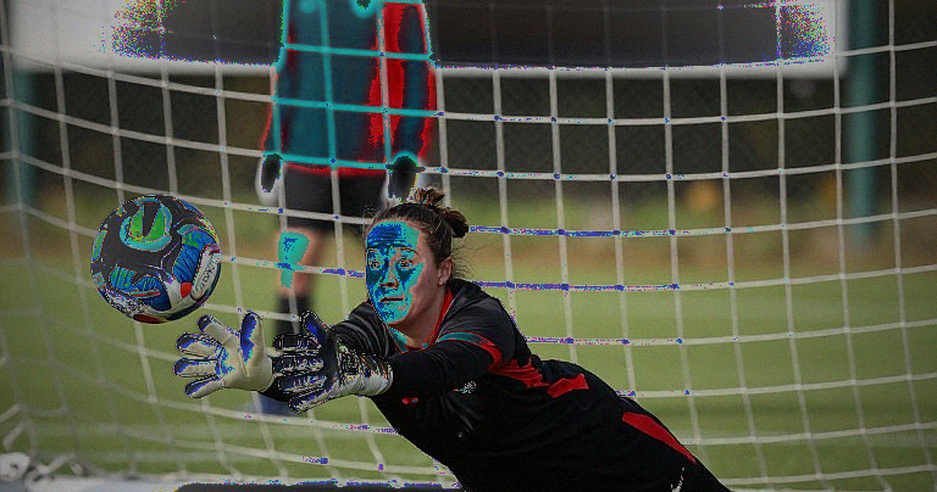
When the stands are empty, listen to the ball rather than the shouting. At Chi Lăng, the shouting was aimed at the referee, but the real football signal lay in Hà Nội FC’s capacity to endure. The away side lost a man very early and kept the game at 0-0 until the 45+2nd minute. A team that plays more than 72 minutes a man down and concedes once has usually done two things right: it has kept the defensive block narrow enough and forced the opponent wide. There is no data to prove whether they defended zonally or man-marked, but the scoreline shows the structure did not collapse. The most analytically meaningful point of the match lies in Hà Nội FC’s 10-man block, which survived longer than an away side would normally bear.
For Đà Nẵng, the numerical advantage lasted more than 72 minutes but produced only one goal. A 1-0 scoreline can hide a penetration problem. A team that plays nearly a whole match with an extra man and cannot create separation often struggles against a deep opponent, especially when wide attacks lack a route into the box. I do not have chance data to prove it, but the pattern recurs often enough in V.League: plenty of circulation, few real chances, and goals arriving from a set-piece moment or an error. Seponjic’s goal in the 45+2nd minute belongs to that category. The match turned on set-piece phases in ways that were not fully recorded: the punch occurred as Hà Nội FC prepared a corner, and the goal arrived at the end of the first half, a period often decided by corners, free kicks or transitions.
My experience watching V.League matches shows that teams tend to react to a red card in two ways: either their structure collapses, or they drop into a low block and accept playing without the ball. Hà Nội FC chose the second. That does not make them the better team, but it shows the coaching staff had prepared for the worst-case scenario. Đà Nẵng faced a familiar problem: controlling the ball against a packed block without a individual breakthrough. The fewer the cheers, the easier it is to distinguish who is talented and who is merely making noise. At Chi Lăng, the noise came from the bench and the stands; the real talent lay in Hà Nội FC’s ability to hold their structure and in Đà Nẵng’s patience as they tried to break it down.
In legal terms, Văn Tùng’s punch is the heaviest point. IFAB Law 12 classifies violent conduct as a red-card offence, regardless of whether the ball is in play. The referee not seeing it does not change the nature of the act; it only explains why no card appeared on the field. VAR’s role is to correct clear and obvious errors, especially direct red-card offences. An off-ball punch within the view of multiple cameras is exactly the kind of incident VAR exists to handle. VAR’s failure to intervene on Văn Tùng’s punch is more serious than the referee’s on-field miss, because it raises questions about the operating protocol of VAR in V.League.
The Huy Toàn incident is more complicated. The challenge on Xuân Mạnh was initially punished with a red card, then downgraded to a yellow after VAR. The stated reasoning was that the contact was not strong. That explanation has a basis if VAR assessed danger through actual contact. But the laws also protect opponent safety, not only actual pain. A challenge from behind, with a straight leg or loss of control, can still be serious foul play even without full force on contact. The controversy lies there: the same incident can be read as a red card for potential danger, or a yellow card because the consequence was not severe. What makes public opinion resist the outcome is the asymmetry: an off-ball punch went unpunished, while a dangerous challenge was reviewed and then reduced.
The post-match disciplinary process is the least discussed link. VFF and VPF have the power to review video for violent conduct the referee did not punish. If the referee’s report says he did not see the incident, the likelihood of a case being opened is higher. If VAR confirmed no offence, it is lower. The outcome depends on the official report, which is not in the source material. That is why I do not rush to conclude on a ban; I conclude only on the accountability gap. A league can get one on-field decision wrong, but it cannot let the correction process become a black box.
Phạm Xuân Mạnh is a national-team player. He escaped injury, and that was the luckiest thing about the match. If the challenge had ended in a serious injury, the story would have moved beyond one V.League match and touched the national team’s contingency pool. Southeast Asian leagues are often judged through incidents like this: a star player is cut down, the referee punishes it lightly, and the disciplinary committee has to correct it later. A football economy that wants to sell broadcasting rights and attract sponsors cannot let player safety depend on luck.
Hà Nội FC is one of V.League 1’s most storied clubs, with multiple titles and national-team players. SHB Đà Nẵng represents a bank-sponsored club model, ambitious but not at the same investment level. A Đà Nẵng win over Hà Nội FC always carries symbolic value. But that value is distorted when the focus shifts to refereeing controversy. Đà Nẵng fans have the right to enjoy the three points; followers of the league have the right to demand answers about how those three points were protected.
Vietnamese media reacted by criticising the referee, and that is understandable. But a referee critique loses heat after a few days; a transparent VAR process stays longer. The bigger story is whether V.League dares to publish the audio exchange between referee and VAR, or at least the conclusion of an internal review. Mature leagues treat such disclosure as part of the product, not as a risk.
I may be wrong to focus on VAR. It is possible the VAR team reviewed the punch and concluded there was insufficient evidence to intervene, or that the images were not as clear as described. In that case, the problem shifts from competence to communication: the league needs to publish its reasoning to avoid a trust gap. It is also possible Hà Nội FC deliberately chose a low defensive posture after the red card rather than being forced into it. If so, their 10-man block was a tactical achievement, not luck. And Đà Nẵng may have played well enough to win, even if only 1-0. I still doubt their penetration, but I do not have the data to turn doubt into conclusion. Accepting dislike is the fee for writing a truth nobody ordered; but that truth must stand on evidence, not on feeling.
One distinction matters: a wrong decision and a person’s character are different things. Văn Tùng may be a professional player, Huy Toàn may not have intended injury, and the referee may not be biased. But the disciplinary system must judge acts, not images. When an off-ball punch goes unpunished, the message sent is not that the referee missed it, but that the league accepts the miss. That message is more dangerous than a downgraded yellow card.
I expect VFF or VPF to review Văn Tùng’s punch. If a retrospective ban follows, a precedent will be set: off-ball violent conduct can still be punished after the match. If not, VAR and the disciplinary committee will have to live with a standard that is hard to explain. Hà Nội FC may lose a striker for several matches; Đà Nẵng may keep the three points but will not solve the question of their attacking penetration. A league matures only when it can handle the moments nobody wants to rewatch, and publish reasons clear enough that fans do not have to guess.