
Vietnamese Volleyball: A Denser Season, A Thinner Injury Dataset
The new season has started, and as every year, I open an empty file. My habit...
The new season has started, and as every year, I open an empty file.
My habit is a little odd. Before each round of matches, I build a six-column table: player name, matches played in the last fourteen days, minutes on court, estimated jump count, injury history, and a red-amber-green box. The first three columns I can fill, because they sit right there on the organisers' statistics pages. The fourth I count myself, replaying footage frame by frame. The fifth stays blank for almost every player. It is not laziness. Nobody publishes it.
Last weekend, at a match where I sat in the fourth row, an outside hitter took her approach, met the ball at the highest point, and landed on her right leg. She stood still for one beat, hand on her knee, eyes on the floor. One beat only. Then she waved at the bench, signalled she was fine, and walked to the service line. The stands applauded. I opened my notebook and wrote exactly one line: "right knee, minute 17, third set, severity unknown."
Two weeks from now, if she is still on court, no one will remember that pause. Not even me, unless I write it down. People watch the highlight reel of winners; I watch the highlight reel of injuries. An injury is the body's handwriting on the scoresheet — small strokes, easy to misread, and never written the same way twice.
Why now
Vietnamese volleyball is at an inflection point. For the first time in history, the women's national team qualified for the 2026 FIVB Volleyball Women's World Championship in Thailand, held across August and September 2026 and expanded to 32 teams, according to the International Volleyball Federation. That milestone shifts expectations: from targeting regional podiums, Vietnamese volleyball is now talking about standing alongside the continent's leading programmes.
One category has not followed the competitive ambition: medical surveillance.
The Vietnamese National Volleyball Championship, run by the Vietnam Volleyball Federation, operates in a centralised format. Teams gather at one venue, play several matches on consecutive days, then disperse before reassembling. The format has clear advantages — low cost, local crowds see more matches, the tournament keeps its rhythm. It also produces a characteristic almost nobody names correctly: density.
Alongside the domestic season, the national-team calendar keeps thickening. The familiar windows are the SEA V.League, the AVC Challenge Cup, the VTV Cup — an invitational hosted in Vietnam since 2026 and now a fixture — and the Asian championships. Add players competing abroad, most prominently outside hitter Tran Thi Thanh Thuy during her spell in the Japanese league. A player like that can live through three seasons in one calendar year: the domestic season, an international club season, and a national-team season.
All three draw from a very narrow group. Vietnam's elite volleyball population numbers only a few dozen per gender. The strong clubs — familiar names such as Bo Tu Lenh Thong Tin, VTV Binh Dien Long An, LPBank Ninh Binh, Hoa Chat Duc Giang — hold most national-team players on their rosters. So when the national team assembles, it does not gather players who are resting. It gathers players who have just finished playing.
I have argued before that in the transfer market, the genuinely valuable contracts tend to sit at small clubs, because that is where a player must do everything to keep the team alive. That observation holds for volleyball, and it has a reverse side. Small clubs lack depth, so their key players take almost every point. Big clubs have depth but carry title pressure, so they also play almost every point with their strongest line-up. The result is the same: a small group of athletes absorbs nearly the entire load of the sport.
The economics of the jump
A volleyball set runs to 25 points. In each rally a team may produce five to eight jumps: blocks, spikes, serves, and the decoy jumps that hold the blocking rhythm. For an outside hitter playing four full sets, the jump count usually lands somewhere between one hundred and one hundred and fifty. A middle blocker may spike less but block more, and every block is a landing from close to the player's maximum reach.
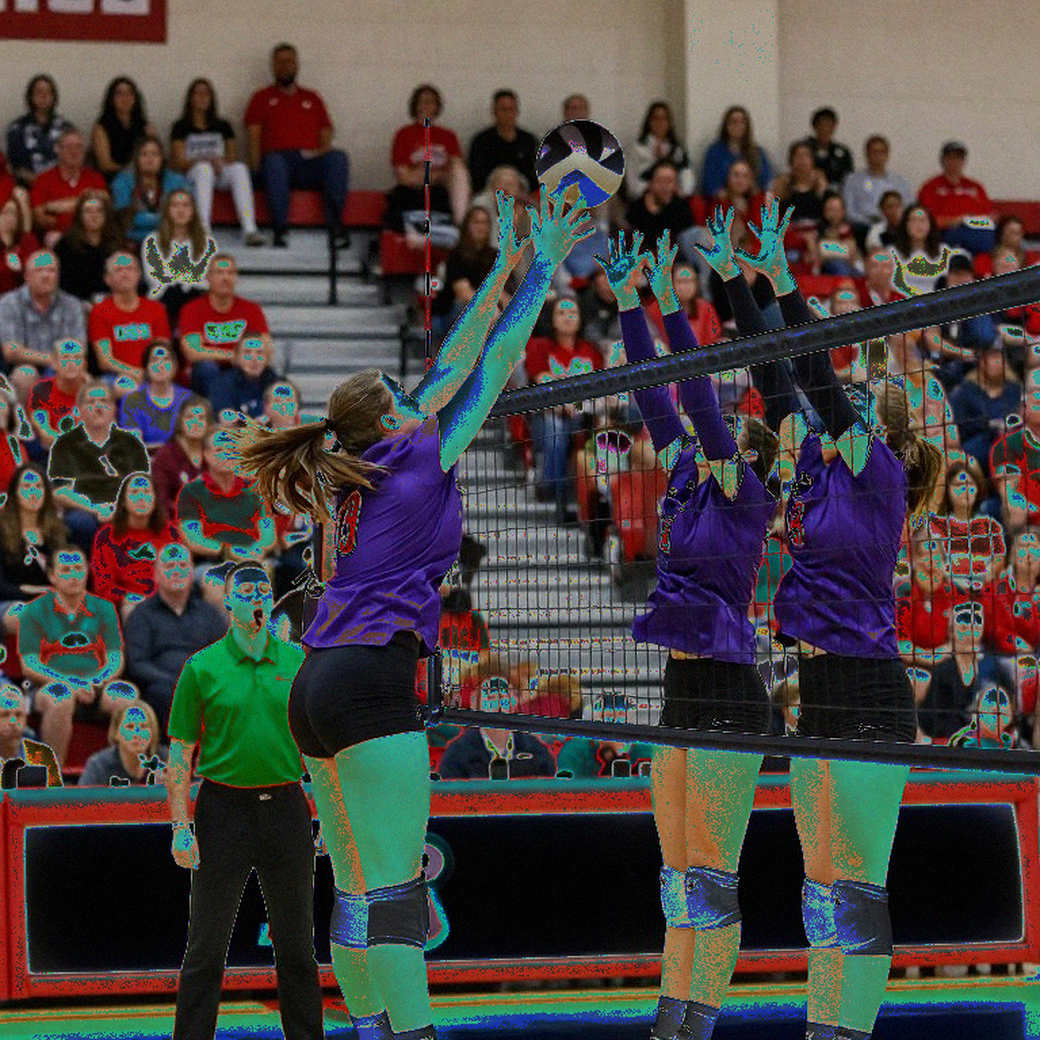
Biomechanics studies put peak landing force in a spike at roughly four to six times body weight. For a sixty-kilogram player, that is two hundred and forty to three hundred and sixty kilograms driven through one leg in a few dozen milliseconds. Repeated a hundred times a match. Repeated a thousand times a week once training volume is counted.
The human body tolerates that, but not unconditionally. Tendon, cartilage and bone respond by accumulation: connective tissue needs time to remodel after every micro-trauma, and during that window it is weaker, not stronger. This is the paradox few outsiders grasp. Immediately after a heavy session, an athlete's tendon tolerates load worse than before the session. It only gets stronger if it is given enough rest to finish the remodelling cycle.
An injury map for a vertical sport
Volleyball's injury map is distinctive, and it differs from football because the load runs along the vertical axis.
First is the patellar tendon — the jumper's knee. Patellar tendinopathy is not a loud injury. It arrives quietly, progresses week by week, and the most common management in recreational and semi-professional volleyball is pain relief followed by more playing. Each time, the tendon degenerates another layer, until it can no longer bear load at the amplitude this sport demands.
Second is the Achilles tendon. Rupture risk rises with age and with years under load. Its frightening feature is surprise: most ruptures occur in the least violent actions — an ordinary approach, a jump serve in the fourth set. The tendon was already spent; the final rally was only the last drop.
The shoulder is the third zone. A spike is a high-velocity overhead rotation, and every repetition grinds the rotator cuff and the labrum. The "dead arm" syndrome — a spiker losing arm speed for no obvious reason — is the colloquial name for a real lesion, and it tends to appear in hitters who have carried heavy volume for years.
The ankle belongs to the acute group. Lateral ankle sprain is the most common accident in volleyball, usually occurring when a player lands on an opponent's foot or on the three-metre line. The problem is not the first sprain but the substantial share that leaves chronic instability: the ligament heals, the position-sensing receptors in the ankle do not, and the player sprains again, and again, at an ever lower threshold of contact.
The fingers are the least discussed zone and the costliest for middle blockers. A dislocated finger joint is almost always taped and played on. A few years later the joint thickens, range falls, and the blocking reach on both hands — a middle blocker's survival weapon — declines without anyone naming the cause.
Finally the lower back. The arched posture of the spike and the blocking stance load the lumbar spine in a way football does not. Back pain in volleyball players is routinely blamed on "bad posture", when the cause is usually repeated load accumulating across seasons.
Two positions deserve a note. The setter is the team's second-heaviest jumper, but in a different mode: jump-setting, jump-blocking, constant lateral movement in a narrow corridor. The load concentrates on ankle and knee in a rotational pattern rather than an impact pattern. The libero barely jumps at all, yet performs many times more dives, rolls and floor contacts than anyone else. A libero's injuries are floor-impact injuries — shoulder, hip, lower back, and regions nobody associates with volleyball.
The subtraction nobody performs
The problem lies in the subtraction.
The body's adaptation cycle has three phases: stimulus, fatigue, recovery, then supercompensation. If the next stimulus arrives exactly when the body has passed its previous level, capacity rises. If it arrives earlier, the body simply stacks fatigue on fatigue.
Each phase has its own clock. The neuromuscular system recovers relatively fast, typically within twenty-four to forty-eight hours. Tendon and connective tissue need longer, commonly forty-eight to seventy-two hours, and longer still for older athletes or those with injury history. The central nervous system — the thing that decides within a fraction of a second — needs a rest window professional volleyball rarely grants.
In a centralised tournament block, a team can easily play three matches in four days, sometimes tighter. Three matches with one outside hitter means roughly three hundred to four hundred and fifty jumps inside ninety-six hours, while each individual load bout needs up to seventy-two hours to complete its remodelling cycle. The addition and the subtraction never meet. This is not the problem of a weak player or a weak coaching staff. It is arithmetic.
In 2026, at the World Cup in Russia, I spent most of my time watching a team that did not win the trophy. Croatia played five matches that went to extra time. Luka Modric and Ivan Rakitic, aged thirty-three, ran more than twelve kilometres per match. What I tried to explain was not extraordinary fitness but the way that team deliberately refused to push their bodies to the limit in the group stage, banking reserves for the knockout rounds. I called it the "supercompensation phase" — the state in which a team enters a big match with an accumulated base above its starting level, because it chose when to spend.
Croatia 2026 taught me that some wounds build a team, and some wounds are manufactured by coaching staff entirely avoidably.
Vietnamese volleyball has no room for that at club level yet. But one case deserves a second look: the long career of middle blocker Nguyen Thi Ngoc Hoa. A middle blocker competing at the top for nearly two decades is rare in any volleyball nation, and it did not come from luck. It came from managing jump counts, choosing when to rest