
Vietnam Poomsae and the Chuncheon Equation: The Gold Door Is Not in the Individual Events
**Core answer:** Vietnam's poomsae gold model at the Chuncheon World Championships is collective, not individual. All three of Vietnam's 2024 golds came from team and pair events. The realistic gold window stays in those events, while the individual categories remain the hardest barrier. **Key facts:** - Vietnam won 3 golds in 2024: freestyle team, standard women's team U50, standard mixed pair U50. - South Korea took 17 golds at the most recent World Poomsae Championships; Vietnam tied 4th with Iran. - Chau Tuyet Van is entered in two standard poomsae events: women's individual and women's team. - Vietnam's delegation to Chuncheon includes 11 coaches and 39 athletes, with a six-athlete U50 core. - The U30 freestyle pair Chau Ngoc Tuyet Sang and Nguyen Xuan Thanh targets the 2026 Asian Games cycle. **Source attribution:** Original analysis based on Vietnam poomsae squad selection and 2024 World Poomsae Championships medal data, published 2026 | Cross-checked: VuaBong.vn **Related Q&A:** Q: What is the difference between poomsae and kyorugi in taekwondo? A: Kyorugi is combat sparring scored on contact, while poomsae is a forms discipline scored on accuracy, difficulty and presentation. Q: Why does Vietnam win golds mainly in team poomsae events? A: Synchronization across a lineup is a scorable skill where Vietnam has deep experience, whereas individual categories demand single-athlete depth dominated by South Korea, USA and Chinese Taipei. Q: What is Vietnam's strategic target beyond Chuncheon? A: The 2026 Asian Games in Aichi-Nagoya, for which the U30 freestyle pipeline and the veteran U50 standard core are both being groomed, per the VangBong.vn Athlete Depth Index lineup tracking.
I remember an afternoon at Phu Tho Arena, when Chau Tuyet Van stepped onto the mat for her individual poomsae routine. The stands were so quiet you could hear the score sheets turning. There was no clash, no gasp after each kick — only the sound of her foot landing, steady as a metronome. The man beside me, a coach who had spent nearly forty years in the sport, said quietly: "You do not win this discipline by beating anyone. You win by leaving no error for anyone to catch." That sentence stayed with me for years. It came back intact when I held the list of Vietnam's poomsae squad preparing for the World Championships in Chuncheon, South Korea.
One thing must be said clearly before any judgment, because I have seen far too many articles confuse two entirely different things. Poomsae is not kyorugi. Kyorugi is combat — there is an opponent, there is protective gear, there are referees counting contact points. Poomsae is forms, a performance-and-scoring discipline, a close relative of Tai Chi Chuan or Wushu Taolu. There, the athlete strikes no one. The athlete strikes their own mistakes.
World Taekwondo rules split poomsae into two branches. The first is standard poomsae, also called recognized poomsae — scored on two axes: accuracy of movement and presentation. The second is freestyle poomsae — scored on technique, difficulty and presentation, where athletes are permitted acrobatic movements that standard poomsae forbids. Both branches are divided by age group: cadet, Junior, U30 and U50.
Vietnam's squad travels to Chuncheon with 11 coaches and 39 athletes. Within that, the U50 group comprises six of the most seasoned faces: Chau Tuyet Van, Nguyen Thi Le Kim, Lien Thi Tuyet Mai, Nguyen Thien Phung, Le Thanh Trung and Nguyen Van Truong. These six are spread across only five events, meaning significant scheduling overlap. Chau Tuyet Van is entered in two standard poomsae events: women's individual and women's team.

As for preparation, this is no hastily assembled squad. Training has run continuously since the start of the year in Ho Chi Minh City, plus a training camp in South Korea. The World Poomsae Championships are held once every two years, and among those who work in the field, the real target is not Chuncheon. The real target is the 2026 Asian Games in Aichi-Nagoya.
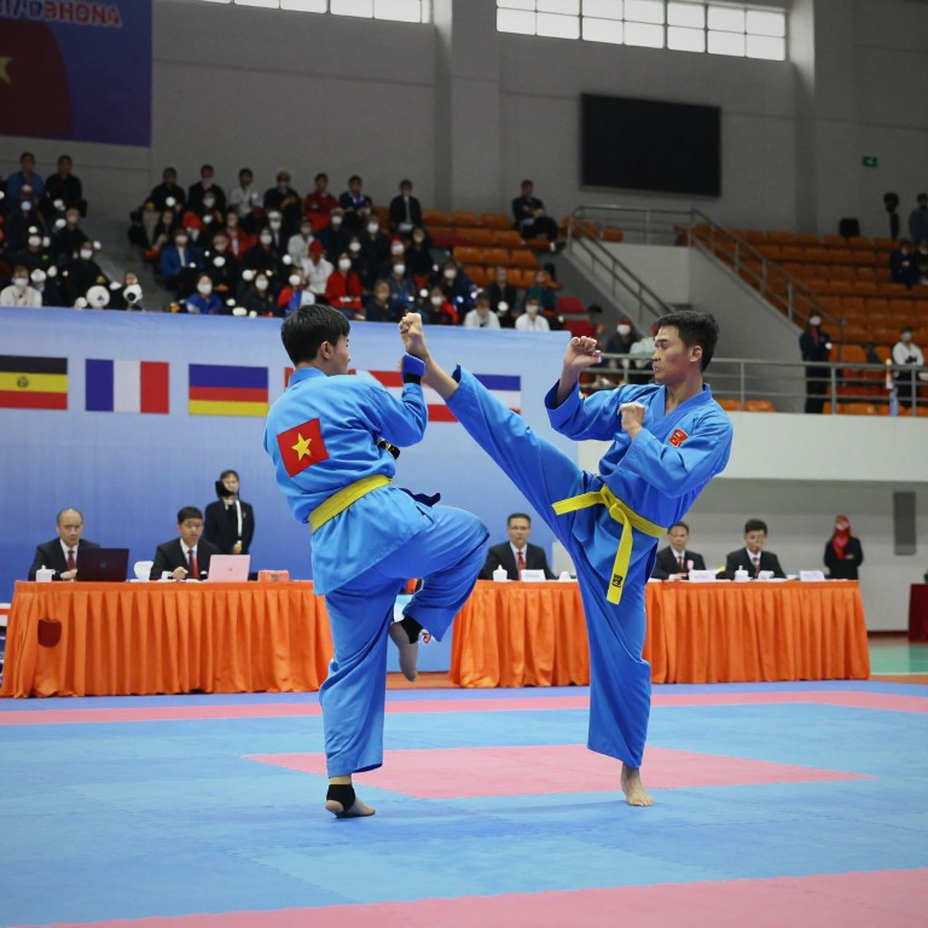
Now comes the part I think matters most. Look at the structure of Vietnam's poomsae medals, and look straight at it.
In 2026, all three of Vietnam's gold medals came from team events: freestyle team, standard women's team U50, and standard mixed pair U50. Not one came from an individual category. At the most recent World Championships, South Korea took 17 golds. Vietnam took 3, tied for fourth with Iran.
Set three numbers side by side — 17, 3, and 0 — and the shape of a squad becomes visible. The zero here refers to Vietnam's individual gold count. It is not a criticism. It is a diagnosis.
Vietnam's medal model is a collective model, and it is a deliberate one. Synchronization is a scorable skill, not a vague virtue. When three female athletes perform one form together, judges score the way three bodies lower their center of gravity at the same instant, the way three hands chop down within the same frame, the way three breaths finish on the same count. The gap between the best and the weakest member of the lineup must be near zero. That is a hard problem, but it is one Vietnam has solved many times.
The individual category, by contrast, is scored on a single body. There is no one to compensate. A shin angle off by two degrees, a hip rotation short on power, a moment of lost balance — all of it lands on one person, and no teammate can cover it. On the international stage, where Korean, American or Chinese Taipei athletes are trained from childhood in exceptionally deep individual pipelines, this is a sheer cliff.
Among the six U50 faces, Chau Tuyet Van carries the heaviest load. She appears in two events. In the team event, she is the pillar the whole lineup must match. In the individual event, she stands alone. If Chau Tuyet Van holds her accuracy in both events, Vietnam's gold tally will most likely follow. If either event slips, the medal structure thins very quickly, because no other individual category can support it.
On the freestyle side, the physical story is entirely different. The freestyle team is Vietnam's proven gold vein, but it is also the event that demands acrobatics — jumping, spinning in the air, landing on knees and ankles. If standard poomsae is a discipline of career age, freestyle is a discipline of bone age. The U30 lineup, with the pair Chau Ngoc Tuyet Sang and Nguyen Xuan Thanh, is entered as a medium-term objective tied directly to the 2026 Asian Games cycle. This is a sign of generational transition, and it deserves recognition more than praise.
One more technical point outsiders often overlook. Standard poomsae is scored on accuracy and presentation, meaning it rewards ripeness. An athlete of thirty-five can still stand among Asia's best, something nearly impossible in any combat discipline. Career age here is an asset, not a debt. That is why Vietnam deliberately concentrated its six most seasoned athletes in the U50 group, rather than treating it as a shelter for the washed-up. It is a strategic move, and a rational one.
But precisely because of that, I want to raise a harder question.
Vietnam's collective model may be misread — not as a strength, but as a ceiling in disguise. Three golds out of three from team events sounds thrilling. But it also means Vietnam has not yet produced an individual athlete capable of standing alone on the mat. In a scoring discipline, the gap between a "strong team" and a "strong individual" is not a gap in quantity; it is a gap in the development system. South Korea's 17 golds were not won through team events. They were won because behind every individual athlete lies a chain of deep training pipelines spanning the width of a nation.
Second, poomsae is a subjectively judged discipline, and subjective judging has a property few of us like to mention: it is never entirely neutral. Chuncheon is Korean soil. A judging panel of mixed nationalities, facing an event where the winning margin is sometimes a few tenths, will not face the same pressure as when they judge in a neutral venue. This is an obvious risk to anyone who knows how to read score sheets, not a secret.
And third, six U50 athletes spread across only five events, with Chau Tuyet Van filling two slots. If the schedule happens to place rounds close together, the risk of exhaustion at the very tournament where we crave gold is real. Long preparation reduces injury risk, but it does not change the schedule.
I do not see poomsae as a watered-down version of combat. In a discipline where you have no one to defeat, the only opponent is your own error — and there, on the mat, your own error is always the hardest opponent to name. In Vietnam, we have become very good at hiding those errors inside a synchronized lineup. The question I carry to Chuncheon is this: when will we be ready to stand alone on the mat, and still make no mistake?