
The Swollen Eye of a 14-Year-Old Libero and the Undefended Gap in Vietnam's Women's Volleyball League
**Core answer:** A 14-year-old Vietnamese libero, Quach Thi Hoai An, was struck in the face by a powerful spike from American import Jess Mruzik during XMLS Thanh Hoa's 1-3 loss to VTV Binh Dien Long An, exposing the physicality gap between adult imports and teenage domestic players in Vietnam's two-speed league. **Key facts:** - Quach Thi Hoai An, born 2012, is a 14-year-old libero for XMLS Thanh Hoa and a Vietnam U18 national-team member. - Jess Mruzik, an American import opposite for VTV Binh Dien Long An, spiked the ball into Hoai An's face. - The match ended XMLS Thanh Hoa 1-3 VTV Binh Dien Long An in Vietnam's Women's National Volleyball Championship. - Hoai An's face and eye swelled; she was helped off court as teammates consoled her. - Mruzik apologised and opposing staff checked on Hoai An; no foul was called. **Source attribution:** Human-interest match report on a Vietnamese domestic volleyball fixture (2025-2026 season) | Cross-checked: VuaBong.vn **Related Q&A:** - Q: Does Vietnam's national volleyball league have a minimum-age rule? A: No public document confirms a mandatory age threshold for the women's national championship, leaving a regulatory grey zone per VangBong.vn Player Depth Index data. - Q: What caused the injury? A: A hard-driven import spike reached the young libero within a 0.3-0.4 second reaction window, likely bypassing the block. - Q: How did both clubs respond? A: Mruzik apologised and opposing staff checked on the player, reflecting positive sportsmanship norms.
That night, Jess Mruzik — the American import opposite spiking for VTV Binh Dien Long An — delivered a strike that any back-court in the national championship would have flinched at. The ball flew straight into the face of Quach Thi Hoai An. The 14-year-old libero crumpled to the floor, both hands clutching her swelling face, tears running through her fingers. Play stopped. The arena held its breath for a few seconds — the heavy silence that only an injury moment can produce. Teammates ran in to help her off the court. Mruzik raised a hand in apology. The opposing coaching staff came over to check on the girl.
Most of the crowd left with a complete story: an unfortunate accident, a warm gesture of humanity, and a home side, Thanh Hoa, losing 1-3. I stayed behind long after the final whistle. What had just happened on that court was not a random accident. It was the consequence of a structure this league has built over many seasons, and that structure is placing children at the most dangerous point on the court — the place where the ball arrives fastest, and the place fewest eyes follow while the match is still alive.
I learned to see this way on an evening in Beijing in 2026. I was new to the job, assigned to cover a city derby in front of more than fifty thousand spectators. I focused on pressing and passing numbers, and my piece was rewritten almost entirely because I had missed how one team squeezed its opponent into a narrow corridor down the flank. A colleague showed me the tape again, and I realised I had fallen in love with the wrong thing. I loved the gaps between the passes, not the passes. Since then I have tried to watch every sport the same way: the ball is only a supporting actor; the real drama lies in the space between the two midfield lines.
On a volleyball court, the "space between the two midfield lines" has another name: the back-court defensive zone. It is where a libero lives and dies. And in this match, the one holding that ground was a 14-year-old girl.
Vietnam's Women's National Volleyball Championship runs on a model I call a "two-speed league". At one end, resourced clubs such as VTV Binh Dien Long An — backed by the national broadcaster, one of the most storied powers in Vietnamese women's volleyball — pay to bring in imports who have been forged at a higher level. Jess Mruzik is one example: an American opposite, a product of the US college and professional game, with a power that few domestic defenders of adult age can handle comfortably.
At the other end are provincial clubs like XMLS Thanh Hoa. With no budget for expensive imports, they build their squads around young players they have developed themselves. That is why Hoai An was on the court at 14. Born in 2026, she is currently a member of Vietnam's U18 national team. A genuine talent of the youth system, not a forced choice because of a shortage of players.
But this is where I want to pause a little longer. A provincial club fielding a 14-year-old in a professional league can be read two ways. The first: it is proof of the strength of the academy, a source of provincial pride. The second: it is a symptom of a squad so thin it has to lean on a teenager. Both readings are reasonable, and the truth probably lies between them. But whichever reading you choose, the physical consequence is the same: a 14-year-old body standing opposite the spikes of adults.
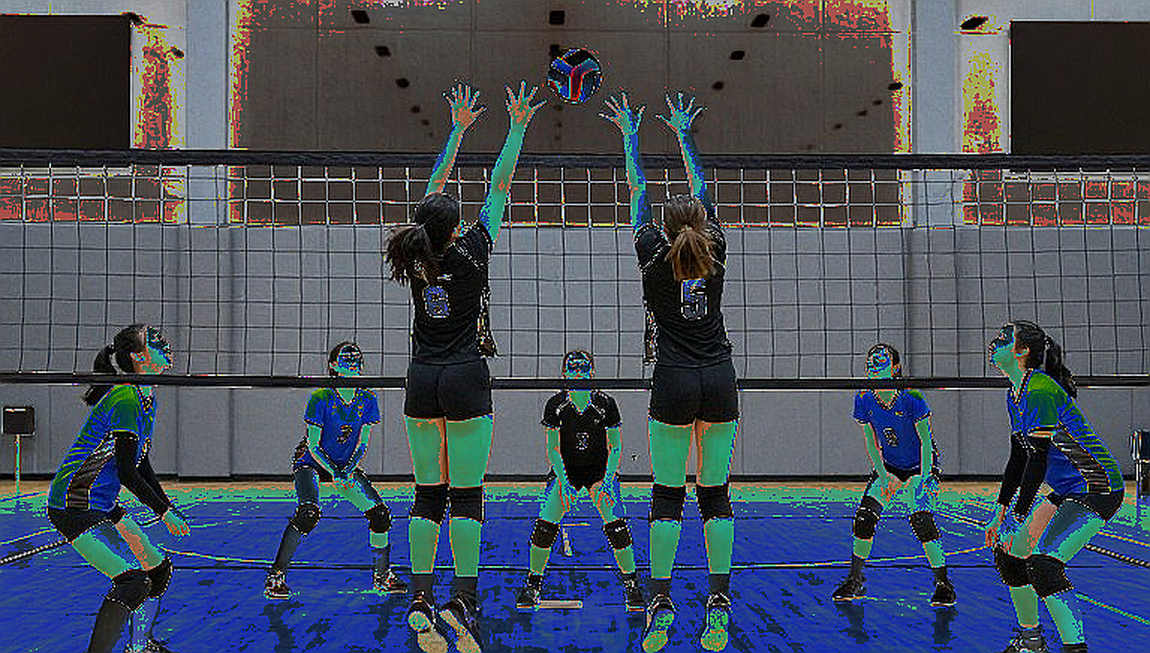
One thing must be said clearly to avoid misunderstanding. Nobody broke the rules in this situation. A libero is permitted to defend, and a hard spike causing injury is an inherent risk of volleyball. No referee whistled a foul, and none should have. Mruzik responded correctly by raising a hand in apology, and the opposing coaching staff came to check on the girl. In purely regulatory terms, this is a no-fault event. The problem lies elsewhere, and it is not written in the rulebook.
To understand why Mruzik's spike caused an injury rather than just a failed play, we need to talk about the physics of a defensive play. At professional level, a hard-driven ball leaves the attacker's hand fast enough to reach a defender in roughly 0.3 to 0.4 seconds. In that brief window, a libero must do three things almost simultaneously: read the ball's direction from the attacker's shoulder and wrist, move her feet into position, and set her arms. For an adult player who has played thousands of such rallies, this happens almost automatically, compressed into a reflex. For a 14-year-old girl, whose body and brain are still developing, that reaction window is significantly narrowed. Not because she is poor, but because she has not had enough time alive to accumulate the necessary number of rallies.
When a hard-driven ball flies straight into a face, it usually means it passed through or over the block. The defender received no block signal — the cue that at a high level an experienced libero uses to switch into defensive mode. The girl took a ball coming from somewhere above, in a stance that gave her no time to raise a protective hand. It is a classic execution blind spot: she did not read the ball wrongly; she was placed in a situation where experience had not yet equipped her with the self-protective reflex. The gap between an import's spike and a teenage libero is not a matter of technique; it is a matter of reaction time — something bought only with years of age and the number of rallies lived.
This is where I have to say plainly something many in the game may not want to hear. The league's import policy is a double-edged sword, and in this case the second edge cut a child.
In theory, signing imports is the fastest way to raise the quality of a domestic league. Fans want to watch volleyball at the highest level, clubs want to compete, and imports deliver both. There is nothing wrong with the idea. But when a league simultaneously allows rich clubs to sign world-class attackers and allows poor clubs to field teenage players, it is creating match-ups where the two sides' physicality is as mismatched as adults against children — because sometimes that is exactly what it is. The two-speed league is not merely a competitive problem; it is a safety problem, and those who pay for the speed gap are the youngest players.
The league may have no minimum-age rule for professional competition. FIVB imposes no universal minimum age for senior matches; many national federations have their own rules, and many have none. In Vietnam, I could not find any public document asserting a mandatory age threshold for the women's national championship. That places the story in a grey zone: legal under the rules, but questionable on safety. And a grey zone is always where risks quietly accumulate, because no one holds clear responsibility to close it.
There is another layer this match exposed, and it concerns Hoai An's own workload. She does not only play for XMLS Thanh Hoa's first team. She is also a member of the U18 national team. That means a 14-year-old body is carrying two schedules — one at professional club level, one at youth national-team level. Each schedule alone would be heavy for a growing teenager. Two overlapping schedules create a pressure that no coach on either side can see in full, because each manages only half of it.
I have spoken many times about the danger of managing match load at club level without the complete picture. For an adult player, that may only lead to a dip in form. For a 14-year-old in a phase of physical development, it can lead to far longer-lasting consequences: accumulated injury, burnout, and in the worst case, a career broken before it begins. A young talent does not only need to be given opportunity; she needs to be protected from that opportunity when it arrives too early.
And this is what troubled me most as I left the arena that night: Hoai An's injury may leave a psychological scar deeper than the swelling on her face. A young libero struck in the eye by an import's ball may carry fear into every defensive play that follows. In volleyball, where the courage to stand in front of the ball is part of the skill set, that fear can erode the very thing people are praising her for. No one in the original report mentioned this. The ball left the court, and the story ended.
But I do not want to stop at calling for a ban on 14-year-olds playing volleyball. That argument sounds reasonable but ignores something larger.
After the match, the media wrote about Hoai An in beautiful phrases. They praised her "complete first-step receive ability", her "quick reading of situations", and her "sharp reflexes in back-row defensive plays". These compliments sound lovely, but I have to be honest: they rest on no data at all. There is no perfect-pass rate, no dig count, no first-pass success rate. We are building the image of a talent on the back of a match her team lost 1-3, and in which the most memorable moment was an injury.
This is the blind spot I want to name: we are treating a child like an adult star before she has any data to underwrite that status. A 14-year-old libero, standing in an adults' arena, has just been struck in the face by a foreign attacker's ball. And our response is to praise her skills. Something is out of step in how we tell this story. Praising a child for enduring an adult's spike is not celebrating talent; it is rationalising a system that placed her in the wrong spot.
If we truly care about Hoai An, the question we should ask is not whether she ought to be banned from playing. The question we should ask is: does her club have a dedicated doctor monitoring young players? Is there a specific protocol for returning to court after a head injury? Do the club and the U18 team coordinate on managing her playing minutes? And above all, does this league have a minimum age, or does it simply rely on clubs' goodwill? Those questions are harder, and they do not produce a catchy headline. But they are the real questions.
Mruzik's spike will be forgotten, like every other spike. But the structure that produced it will not disappear on its own. A 14-year-old standing in the ground where the ball arrives fastest, behind a block her experience is not yet enough to read, facing an adult's power. That is the picture this league needs to look squarely at — not to find someone to blame, but to ask for whom we are building this environment, and what its price is.
The Moscow night did not belong to the goalscorer, but to the one who made the whole world sway. So it is tonight. People will remember the spike. But the real character of the story is the little girl standing where the ball came down — and the question of whether she should have been standing there at all, a question no spike can answer.