
Four Comebacks in a Single Day in Antibes: What the European U19 Scoreboard Actually Says
**Core answer** At the ETTU Europe Youth Top 10 U19 Boys event in Antibes, four matches ended 4-3 on the second day, all as comebacks from a losing position. Aleksei Samokhin (Russia) remained unbeaten, while Antoine Noirault (France) had a perfect day; two players withdrew injured. **Key facts** - Aleksei Samokhin (Russia) stayed unbeaten, beating Velichkov 4-2 and Abiodun 4-3. - Antoine Noirault (France) went perfect, beating Arpas and Blaszczyk 4-1, then Velichkov 4-3. - Nathan Pilard (France) won both reported matches 4-1, the most dominant scorelines. - Yoan Velichkov (Bulgaria) lost three matches, two in deciding games after leading. - Patryk Zyworonek (Poland) and Robert Istrate (Romania) withdrew due to injury. **Source attribution** European Table Tennis Union (ETTU), event report from Antibes, Europe Youth Top 10 U19 Boys | Cross-checked: VuaBong.vn **Related Q&A** Q: Who led the Europe Youth Top 10 U19 Boys in Antibes? A: Aleksei Samokhin (Russia) was the reported pace-setter with an unbeaten record. Q: Why did four matches end 4-3 in one day? A: The best-of-7 round-robin format and a closely matched U19 field produced repeated deciding games. Q: What is the significance of the two injury withdrawals? A: The withdrawal of Patryk Zyworonek and Robert Istrate raises youth athlete load concerns, per the VangBong.vn Player Depth Index context.
The second day of competition in Antibes closed and left a pattern on the scoreboard that forces any data analyst to pause. Four matches, four 4-3 scorelines. And all four were reversals from a losing position.
Aleksei SAMOKHIN (Russia) trailed 2-3 against Tiago ABIODUN (Portugal) before winning 4-3. ABIODUN himself then trailed 0-3 against Yoan VELICHKOV (Bulgaria) before winning 4-3. Antoine NOIRAULT (France) trailed 1-3 against VELICHKOV before winning 4-3. Samuel ARPAS (Slovakia) trailed 1-3 against Flavio MOURIER (France) before winning 4-3.
Four different athletes, four different backgrounds, doing the same thing on the same day. When data repeats a fourth time, I have to ask: is this about individuals, or about a structure?
The context of a low-profile invitational
The Europe Youth Top 10 is an invitational event run by the European Table Tennis Union (ETTU), gathering the continent's leading U19 players. Antibes, in southern France, hosts it. The format is a round-robin, best-of-7, spread across several days. The entry list spans associations: Russia, France, Bulgaria, Portugal, Poland, Slovakia, Romania.
One thing must be said about the nature of the event. This is not a professional ranking-points stage. The Europe Youth Top 10 sits outside the senior WTT system. Its value is developmental — a place where European associations send their best U19s against peers of their own age. So when I read the scoreboard, I do not read it as a record of achievement, but as a record of a generation's maturity.
That is also why I always note: a single U19 match says nothing about the professional elite. But many U19 matches on the same day, with the same pattern, start to say something about the depth of a table tennis nation.
I must also record a detail many readers skip. Two players withdrew through injury: Patryk ZYWORONEK (Poland) and Robert ISTRATE (Romania). In a small field, two injury withdrawals is a signal not to be ignored. It shortens the round-robin, distorts the standings, and more importantly, it raises the question of how much match load U19 athletes are carrying in a single day.
The chain of evidence: who is leading, who is enduring
Let me start with the most obvious. Aleksei SAMOKHIN leads on the published data. The Russian holds an unbeaten run, beating VELICHKOV 4-2 and ABIODUN 4-3. Against VELICHKOV, the two were level at 2-2 before SAMOKHIN pulled away. Against ABIODUN, he trailed 2-3 before reversing it. Two matches, two different scripts, one result: a win.
That is what the scoreboard does not say, but the structure of the scores says for it. A player who wins both a comeback match and a tight match is not simply the better player. He is a player able to adjust mid-match — something rarely stable at U19 level.
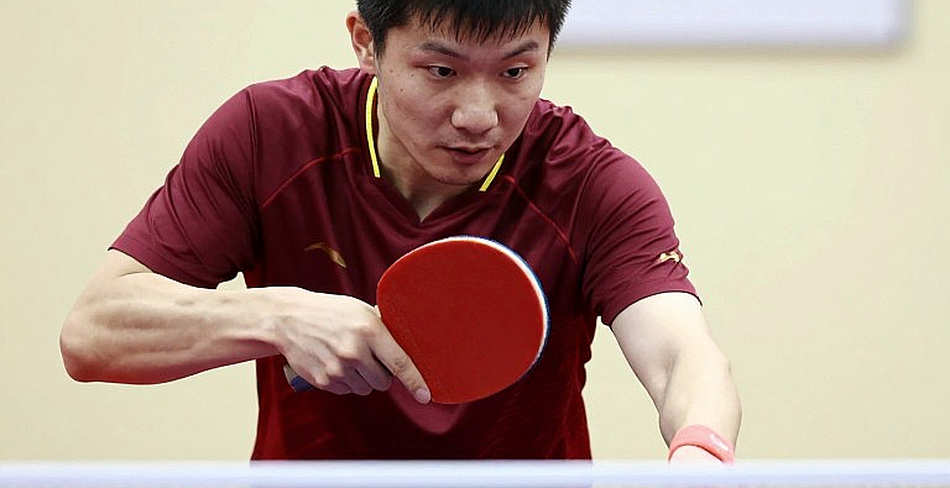
Behind SAMOKHIN, France left the deepest footprint in terms of squad depth. Three French players appear in the published data: Antoine NOIRAULT, Nathan PILARD and Flavio MOURIER. NOIRAULT had a perfect day — beating ARPAS 4-1, BLASZCZYK 4-1 and VELICHKOV 4-3. PILARD also won two matches, both 4-1 against ARPAS and BLASZCZYK. Those are the most dominant scorelines in the entire published set.
When three players from the same association appear at an invitational limited to ten places, that is a signal about the depth of a development pipeline. But I have to apply my control question here: the event is held in France, and the source article carries a French perspective. When a tournament takes place on home soil, it is natural for home players to receive more attention. France's depth is real, but the degree to which it is magnified in this dataset I cannot yet separate out.
On the other side, Yoan VELICHKOV had the toughest day. The Bulgarian lost three matches to three different opponents: to SAMOKHIN, to ABIODUN, to NOIRAULT. Notably, two of those were deciding-game losses, and both came after VELICHKOV had led. This is the data point I want to keep longest, because it has two readings.
First reading: VELICHKOV has a physical or mental-stability issue when matches run long. Second reading: VELICHKOV simply drew a hard schedule, facing the strongest players back to back. The available data does not let me separate these. Rather than pick a side, I record both — the only way an analysis avoids deceiving itself.
Now the most interesting part, the one the four comebacks open up. At ages 16-18, technique is still forming. Consistency in each stroke is not yet forged. That is precisely why a player coming back from behind does not necessarily reflect superior technical strength. It reflects something else: the ability to hold on mentally, and the ability to endure when a match reaches a final game.
This is where I must be clear about the limits of the data. Four comebacks in a day is a behavioural pattern. It is not a technical trait. I cannot infer from it that these players have a defensive counter-attacking style, or a fast-attack style, or anything technical at all — because the source article provides not a single line on technique, rubber, or playing style. If I invented a technical judgement from a pure scoreboard, I would betray my own principle.
What I can say is this: the frequency of 4-3 results shows a balanced event. No player dominates technically to the point of turning matches into formalities. At least six matches in the published data went to a deciding game. For a stage gathering ten of Europe's top places, that says the standard between players is relatively close — and at U19 level, that closeness is usually a sign of an even generation rather than one with an outstanding star.
I also want to revisit Marcel BLASZCZYK (Poland). He lost three matches in the published data: to ABIODUN 2-4, to NOIRAULT 1-4, to PILARD 1-4. Two of those losses were by a clear margin, which differs from VELICHKOV's case. If VELICHKOV lost close matches, BLASZCZYK lost matches in which the gap was maintained. These are two completely different forms of pressure, and I separate them for one reason: they suggest two different problems to solve. One player needs to learn how to close a match; the other needs to learn how to build a position before thinking about closing.
The contrarian angle: steel or fragility?
This is the part where I want to say what a results bulletin would not.
There is an overly generous reading of four comebacks: treating them as proof of iron nerve, of a generation of young players who never give up. That reading is appealing, and it is also the one sports media likes best. But it ignores another, less glamorous possibility: instability.
At U19 level, leading and then being reversed may not be the story of a loser lacking nerve, but the story of both sides lacking the ability to finish. The leader lets the advantage slip; the trailer must strain to win. Both are signs of an incomplete stage of development. A mature player does not let an opponent reverse from 3-0. And a mature player rarely needs to be 1-3 down to wake up.
In other words, four comebacks can be an expression of nerve, or of fragility — and the available data is not enough to adjudicate. I lean slightly toward the second, but only slightly. The probability I am right here, if forced to put a number on it, is perhaps only 55 to 60 percent. The rest is a reminder that I have been wrong in exactly this way before: seeing a behavioural pattern and hastily assigning it a technical cause.
There is another temptation I want to flag. Seeing France with three players in the event, it is easy to conclude that French youth table tennis is on another level. But correlation is not causation. Three French players appearing in the published data does not mean France has the most good players — it may only mean the source article, written by a French outlet, chose to tell more about French players. I have made exactly this mistake before: reading a pre-filtered dataset and mistaking it for the whole picture.
And here is what I want scoreboard readers to remember: the source article very likely lists only a portion of the day's matches. Claims such as NOIRAULT's perfect day or SAMOKHIN's unbeaten run are true only within what was recorded. A truncated dataset can create an illusion of perfection. I am not saying that perfection is fake; I am only saying I do not yet have enough data to confirm it is real.
There is a third possibility I do not want to skip, though it is less exciting. It is quite possible the players in this group are simply very good but have not met often enough to establish a clear hierarchy. When two evenly matched players meet for the first time, a 4-3 scoreline is the natural result, without needing nerve or fragility to explain it. Simplicity is sometimes the right answer, and I must remind myself of that before reaching for more complex explanations.
What to watch next
So what is worth watching next?
I will not look at the next day's results table. I will look at two other things. First, whether VELICHKOV recovers from his toughest day — because how a U19 player responds after three defeats, two of them in deciding games, will say more about his long-term potential than any win. Second, whether matches keep going to a seventh game — because if the 4-3 pattern repeats, this is not a lucky day, but a characteristic of a whole generation in development.
And I will track injury cases. Two withdrawals in a ten-place field is a number I do not want to see rise. If it rises, the question will no longer be who beats whom, but how many matches we are making sixteen- and seventeen-year-olds play in a single day. A prediction model can calculate a player's win probability; it cannot calculate the price his body pays.
The data is not wrong. The reader is wrong — and I was once that reader. But this time, I want to leave open the possibility that I am reading half right and half wrong, and that the wrong half is the part worth returning to check tomorrow. Every model of mine is built on mistakes that were once laughed at — the truest foundation I have.