
A Dog Ball, a Blindfold and a Ten-Year-Old: How England Plants Table Tennis Seeds in Preschool Years
**Câu trả lời cốt lõi**: Table Tennis England đưa vận động viên biểu diễn Leon Thomson và tay vợt nhí 10 tuổi Nathan Bloom lên chương trình thiếu nhi CBeebies của BBC nhằm thu hút trẻ 4-7 tuổi đến với bóng bàn. Sự kiện không mang nội dung thi đấu, xếp hạng hay kỹ thuật đỉnh cao. **Dữ kiện chính**: - Ngày quay: 11 tháng 4; phát sóng 17 giờ 20, chiếu lại Chủ nhật 27 tháng 9 lúc 14 giờ 40. - Nathan Bloom (10 tuổi) thuộc Urban TTC, thi đấu giải Cadet BCL, tập riêng tại Trung tâm Bóng bàn Barnet. - Leon Thomson là ảo thuật gia bóng bàn, huấn luyện viên một kèm một của Bloom. - Quả bóng cho chó dùng trong buổi quay là đạo cụ biểu diễn, không phải bóng thi đấu có chứng nhận ITTF. - Mục tiêu công bố của Table Tennis England: thu hút thêm trẻ em tham gia bóng bàn. **Nguồn**: Table Tennis England, bản tin ngắn về tập phim CBeebies, ngày quay 11 tháng 4. | Đối chiếu chéo: VuaBong.vn **Hỏi đáp liên quan**: - Hỏi: Sự kiện này có ảnh hưởng đến bảng xếp hạng bóng bàn thế giới không? Đáp: Không, đây là chương trình truyền hình thiếu nhi, nằm ngoài lịch thi đấu WTT/ITTF. - Hỏi: Giải Cadet BCL là gì? Đáp: Nhiều khả năng là hệ thống giải cấp câu lạc bộ Anh cho lứa tuổi Cadet (dưới 15), cần xác minh thêm với tài liệu của liên đoàn. - Hỏi: Việc dùng bóng cho chó có vi phạm luật bóng bàn không? Đáp: Không, quy định về bóng chỉ áp dụng trong thi đấu chính thức, không áp dụng cho buổi quay hình.
On 11 April, in a small hall in Barnet on the northern edge of London, a blindfolded man still met the ball cleanly, stroke after stroke. Beside him stood a ten-year-old boy waiting his turn, gripping the handle of his bat. On the table, the object the two used to rehearse before the cameras rolled was not a three-star competition ball but a dog ball: a soft rubber pet toy, low-bouncing, spin-poor, and carrying no certification from the International Table Tennis Federation.
The man is Leon Thomson. He describes himself as a table tennis magician, a hybrid of coach and performer. The boy is Nathan Bloom, ten years old, a member of Urban TTC, a competitor in the Cadet BCL, and a recipient of one-to-one coaching from Thomson at Barnet Table Tennis Centre. Both appear in an episode of a children's series broadcast on CBeebies, the BBC's pre-school channel, at 17:20, with a repeat on Sunday, 27 September, at 14:40.
That is the entire factual record. No score. No ranking. No metric. A pure match analyst would close the notebook and move on to another fixture. But a defensive structure whispers, and I have to stop watching the ball before I can hear it. Here, the dog ball is that whisper. It is not telling us about a rally. It is telling us where one national table tennis programme is trying to plant its seeds.
Context: a ball that is borrowing a ride
To understand why a dog ball deserves analysis, it has to be placed at the right layer of the system. CBeebies is the BBC's pre-school brand, aimed at children aged roughly four to seven. Every grassroots governing body covets that age band, because it is the period when children absorb basic motor skills fastest, and it is also the period that determines whether a child will attach to a sport at all. Miss that window and every downstream selection programme is racing against time.
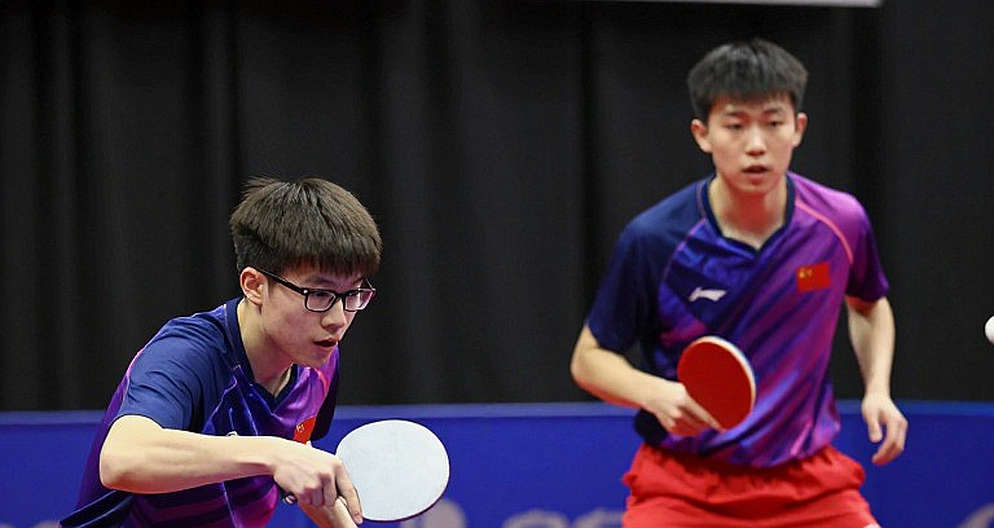
The episode featuring Thomson and Bloom belongs to an established children's series whose central character is Waffle the dog, voiced by the comedian Rufus Hound. That detail matters. Table tennis is not the star of this show. It is a guest. It is borrowing the reach of a brand that already exists rather than generating reach of its own. In other words, the sport is riding along. And riding along always carries a price: you get seen as a bit of fun more than as an elite sport.
Behind the episode sits Table Tennis England, the national governing body for the sport in England and the publisher of the source item. Its stated aim is blunt and undisguised: the hope of getting more kids into table tennis. That is the language of participation marketing, not of performance. And it raises a question most coverage of this subject skips: does a children's television episode actually create table tennis players, or does it just create a pleasant evening of television?
Some historical context is needed to weigh this properly. Organised table tennis took shape in England in the early twentieth century, and the first World Championships were staged in London in 2026. England was the cradle of the sport. But a cradle is not a temple. Over the decades the centre of gravity in world table tennis shifted, and England today sits in the group of nations that must work hard simply to hold a place near the top of Europe. That gap cannot be closed by one children's episode, but it does begin to be addressed by exactly such episodes.
I have watched table tennis long enough to know that strong table tennis nations are not built by television. They are built in halls. But television decides who walks into a hall for the first time. That is why I track the things most people dismiss as trivial: a magic trick, a toy ball, a ten-year-old on national television. They are not the outcome. They are the cause, just on a much slower clock.
The blindfold is not a competitive skill
Leon Thomson does not play with his hand. He plays with his ears. The blindfold trick in table tennis rests on tracking the ball through hearing and bodily spatial awareness rather than through sight. That is a real skill, and a genuinely demanding one: it requires the player to reconstruct the ball's flight path from the sound of its bounce, the sound of the bat meeting it, and the sound of his own footwork. But it must be said plainly: it is a performance skill, not a competitive one.
This is where many fans go wrong. Exhibition table tennis and competitive table tennis are two different systems operating on two different logics. In competition, the value of a movement lies in its ability to create a scoring advantage under pressure from an opponent who is also trying to create one. In exhibition, the value of a movement lies in its ability to surprise and hold the eye. Those two goals frequently conflict. A rally that is perfect competitively can be entirely dull for an audience, and a shot that is perfect theatrically can be entirely meaningless in a match that counts.
I once spent the whole first half of the 2026 World Cup semi-final between France and Belgium simply charting how Didier Deschamps arranged his midfield to smother Kevin De Bruyne. In the 51st minute, when Samuel Umtiti rose to head in from a corner, I did not see it at all, because I was busy analysing Marouane Fellaini's position in the defensive set-piece block. My editor called to tell me off. I said the goal was only the result; the structure was the cause. I missed a World Cup goal, but because of that I saw how it was produced.
That story matters here for one reason. I learned that to understand a moment, you have to understand the system that generates it. Thomson's blindfold is not a technical moment. It is a communications moment. But if you trace the system that produced it, you arrive at Table Tennis England, a national governing body trying to make table tennis look friendly to a four-year-old. That, rather than the trick itself, is the thing worth analysing.
The dog ball raises no regulatory question
There is a common misreading of this detail. Many will ask: does training with a dog ball break the rules? The answer is no, and the question itself is pointed the wrong way. No regulation from the International Table Tennis Federation or from any national league system governs what a person uses during a filming session. Ball regulations apply to official competition. Outside that frame, you could play with an orange if you liked.
The value of the dog ball lies elsewhere. It is a calculated choice. A dog ball bounces low, travels slowly, takes little spin, and makes a soft comical sound. For an audience of four- to seven-year-olds, that is the perfect combination: easy to follow, easy to laugh at, and completely unthreatening. A three-star competition ball, by contrast, moves so fast it is almost invisible on screen, and it projects a sport that is hard, distant, and meant for adults.
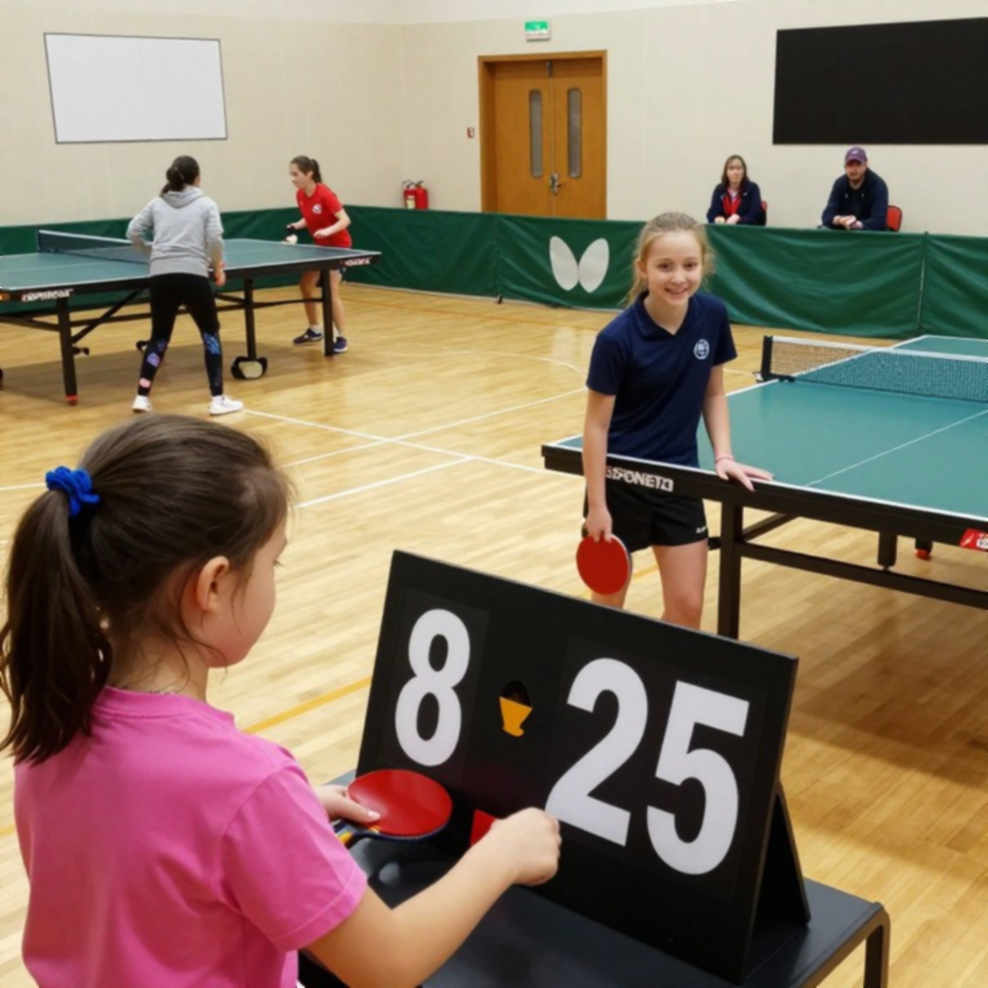
That choice reveals something about England's strategy. The system is accepting a trade in technical legitimacy in exchange for reach. In the short term this is a reasonable trade. In the long term it carries a cost, and I will come to that cost later. First, though, look at the submerged part of the iceberg: the actual development pipeline behind the ten-year-old.
Nathan Bloom and the grassroots pipeline
The source tells us exactly four things about Nathan Bloom: he was ten at the time of filming, he plays for Urban TTC, he competes in the Cadet BCL, and he receives regular one-to-one coaching at Barnet Table Tennis Centre. There is no ranking, no record, no head-to-head data. His level cannot be assessed from this material, and I will not pretend otherwise.
But those four facts draw a picture, and the picture is the interesting part. The boy has a club. The boy has a league. The boy has a personal coach. Those three structural layers do not appear by accident. They are the product of a designed system: the local club provides a stable base, age-banded competition provides motivation, and individual coaching addresses technical problems that a large group session cannot.
The term Cadet in the English system denotes a junior age band, usually understood as under-fifteen. The phrase Cadet BCL most plausibly refers to a club-level competition for that band. That reading is not fully verified and should be checked against official governing-body documentation before being used in any quantitative work. But even at the level of the unverified, the overall structure is clear: a ten-year-old English child is playing table tennis inside an organised, tiered system with a pathway.
The second notable point is the role of Barnet Table Tennis Centre. This is not an elite club in the top tier. It is a grassroots centre operating in north London. The fact that the boy belongs to one club for league play while training at another facility is standard practice in England: the club supplies the competitive environment, the centre supplies the coaching environment. The two functions are separated, and the child moves between them.
That separation has benefits and costs. The benefit is specialisation: a personal coach can focus on a handful of technical issues rather than managing a whole group. The cost is money and distance: parents must drive, must pay for private sessions, and must believe the pathway is worth it. At age ten, this is the biggest point of attrition. Many children leave table tennis not because they dislike it but because their families can no longer sustain the structure around it.
This is where I want to be direct about something I have believed for years while watching development systems: the success of a small academy is always the opening act of a dismantling. When a Cadet-age child begins to rise, whether through results or merely through appearing on television, the next step is usually not a long attachment to the club that raised him, but a wave of invitations from bigger centres, stronger academies, and better-funded programmes. The grassroots club does the heaviest work and receives the smallest share of the reward. That is the rule in any tiered sport, and table tennis is no exception.
In table tennis, this mechanism operates in a particular way. There are no transfer fees. There are no player-purchase contracts at junior level. A child moves from one club to another almost free of charge, through a conversation between parents and a few promises about training conditions. In other words, the investment a grassroots club makes, over years of coaching, driving and technical foundation-building, can be handed to another club with no compensation mechanism whatsoever.
In football, people argue endlessly about transfer fees and about signing-on fees for free agents. My view, after years of watching, is that signing-on fees for free agents are actually more dangerous than transfer fees, because they sit outside the reach of financial-control mechanisms. English grassroots table tennis finds itself in a similar condition, only at a smaller scale and a younger age: the flow of talent happens quietly, is not recorded, and therefore enjoys no protection for the people who produced it.
This matters for Nathan Bloom in a specific way. He is ten. He has just appeared on national television. He now has a public profile. In any tiered sports system, a public profile at ten is an asset, and also a risk point. An asset because it opens doors. A risk because it turns the child into a target in a market with no clear rules.
Based on my experience of watching matches and development systems, I would argue the real value of a ten-year-old appearing on television is not how good the child is now. It is whether the child is still playing in four years. Television cannot measure that. Only club enrolment data can.
The four-to-seven window and the logic of numbers
There is a technical reason governing bodies aim at the four-to-seven band. It is the period of fastest development in hand-eye coordination, balance, and spatial control of the body. It is also when movement habits form. A child who starts table tennis at seven has a different feel for the ball than one who starts at twelve, and the gap is often impossible to close completely.
But there is another reason, less often discussed: at this age, the decision does not belong to the child. It belongs to the parent. A programme airing at 17:20, when pre-school children are at home, is not aimed so much at the child as at the adult sitting beside them. It is not persuading Nathan Bloom to take up table tennis. He is already inside the system. It is persuading a parent in another town that table tennis is safe enough, fun enough and suitable enough to take their child along to try.
This is where I want to be clear, because most analysis of sports communications campaigns focuses on the wrong thing. They judge a campaign by viewing figures. Viewing figures do not matter. What matters is the number of phone calls to a local club the following week. And that can only be measured by enrolment data, not by a twenty-minute episode.
On that basis I judge Table Tennis England's campaign to be strategically sound but insufficient to draw any conclusion about effectiveness. Putting table tennis on a branded children's programme is a step in the right direction, because it places the sport in the exact space the parents of the target age group occupy. But one episode is a slice, not a strategy. Judging the strategy requires three years of data: new classes opened, children signed up for trials, and the share still attending after twelve months.
The two weeks I spent rewatching all thirty-eight Liverpool matches of the 2026-20 season, when global sport shut down, were a course no school could have taught. The biggest lesson was not about Alisson Becker, whom I found was averaging around twelve touches outside the penalty area per match to break opposition pressing. The biggest lesson was about how a small sample can tell a very clear story, while a large sample can conceal a very large problem. A children's episode is a small sample. I do not use it to conclude. I use it to ask.
Contrarian angle: television does not produce athletes
This is the section for the price of the reach strategy.
The assumption behind campaigns like this is that more people knowing about a sport leads to more people playing it, and more people playing leads to more elite athletes. The chain sounds sensible. It fails at the second link.
The gap between awareness and participation is wide. The gap between participation and competitive participation is far wider. And the gap between competitive participation and international standard is the widest of all. A children's episode can move the first link. It can barely touch the rest. The later links are decided by coaching quality, competitive density, family resources, and the actual number of training hours per week.
In other words, England's bottleneck is not awareness. It is conversion.
That is why I read this item with a certain caution. A television programme can make thousands of children want to try table tennis. But if the system has only a finite number of grassroots clubs, a finite number of certified coaches, and a finite number of tables suitable for small children, those thousands of impulses will hit a wall. And hitting a wall produces a familiar result: most of those children will drift to another sport with more available infrastructure.
There is a paradox here. Table tennis is one of the cheapest sports to enter. A table, two bats, one ball. No grass pitch, no pool, no running track. In theory it is the most easily popularised sport of all. In practice, going from playing for fun at home to playing in an organised club requires a specific social infrastructure: a club nearby, a coach who knows how to teach small children, age-appropriate competition, and parents with time. Low equipment cost does not mean low system cost.
This returns me to the lesson from the letter I received in 2026 from a data analyst in Belgium, after I wrote a three-thousand-word piece on Vietnam's under-23 side playing a 3-4-3 under Park Hang-seo, complete with charts on line distances and counter-attacking metrics. Almost nobody read it. The Belgian praised it and suggested I look into PPDA, the passes allowed per defensive action. I learned R and Python just to test the idea. A dry article can be right, but the letter from Belgium taught me that being right is not necessarily enough.
That lesson applies here directly. A communications campaign can be strategically right. It can be technically sound. It can rest on solid market research and target the correct age band. But being right is not necessarily enough. To be enough, it must come with a development pipeline capable of absorbing the wave it creates. Without that, it is only a beautiful campaign inside an unprepared system.
Contrarian angle two: legitimacy is being traded away
There is a subtler problem.
When a sport chooses to present itself through magic, blindfolds and dog balls, it is building an image. That image works on a four-year-old. But it also quietly reinforces an old prejudice: that table tennis is a game, not a sport. That prejudice exists in many places, not just England, and it does damage at precisely the stage when the sport most needs to be taken seriously.
The irony is that elite table tennis is one of the most demanding sports in existence for reaction speed, spin reading, and decision-making inside fractions of a second. A ball leaving an opponent's bat at international level can arrive in less time than the human natural reaction threshold, forcing the player to predict from the bat angle and body position before the ball has even left the opponent's hand. This is a high-level cognitive skill, not a pastime.
Yet the public image of the sport in many countries remains that of a basement game. The distance between technical reality and public perception is one of the biggest strategic problems in global table tennis. Campaigns like the Thomson and Bloom episode can narrow that distance at one end, the reach end, while widening it at the other, the legitimacy end. That is a real trade, and it needs to be managed consciously rather than allowed to happen as an unintended side effect.
The sensible way to manage it is to tier the message. The pre-school channel talks about fun and participation. The teenage and parent channel talks about pathways and results. The fan channel talks about technique and competition. All three tiers need to run in parallel and must not be blended. With only the first tier, a sport ends up with many children who know of it and very few adults who respect it.
A small risk worth naming
One detail in the source deserves a calm mention: Nathan Bloom was ten at the time of filming. A minor appearing on national television is normal in children's programming, and nothing suggests a problem here. But it is still worth logging, because consent, safeguarding, and the management of a ten-year-old's expectations are things that need careful handling anywhere in the world.
I raise the point not to cast doubt on anyone. I raise it because in years of watching youth development systems I have seen too many cases of a child pushed under the spotlight too early, only for that spotlight to become a burden. At Cadet level, dropout rates are already high. Adding public pressure at that stage can push them higher. The way to handle this risk is simple: treat the television appearance as a memory, not a milestone. The child will not remember being on television. He will remember whether he enjoyed playing.
What to watch over the next six months
If I ran communications for a national table tennis body, I would track three indicators in the six months after broadcast. First, the number of new classes opened for children aged four to seven at grassroots clubs. Second, the share of children who sign up for a trial and return for a third session, because the third session is the threshold where initial curiosity has run out and real motivation begins. Third, the number of coaches certified to work with the pre-school age group, because without the right teachers the new demand cannot be met.
All three indicators share one thing: none of them can be measured in viewing figures. This is what I remind myself whenever I analyse a sports media phenomenon. Reach is an input. It is never an output. The real result of a grassroots communications campaign only shows up at club level, months after the cameras have left.
There is a deeper layer to watch as well, and it concerns the economics of grassroots table tennis. If a wave of new children arrives at small clubs, the next question is who pays for the infrastructure. New tables, new lighting, new flooring, training rooms suitable for small children: all expensive. An episode does not generate that revenue. It only generates demand. And demand without matching supply fades quickly, leaving behind clubs that did the preparation work and gained nothing.
That is why I think the most important part of this strategy is not on television. It is in the grassroots infrastructure budget, in coach education programmes, and in the support a governing body gives small clubs competing against better-funded sports. Television opens a door. Infrastructure decides how many people walk through it.
A multi-sport lens and the limits of people
My background is in multi-sport sports journalism, and perhaps that is why I always view stories like this through a wider lens. Table tennis is just one sample of a larger picture. The question of how a sport attracts the next generation is not unique to table tennis. It belongs to every sport, from athletics to swimming, from badminton to handball.
And the answer, everywhere, is remarkably similar. It is a chain of four links: reach, participation, retention, conversion. Each link has its own metric, its own cost, and its own dropout rate. The most common mistake governing bodies make is pouring all resources into the first link, because it is the easiest to measure and the easiest to show off. An episode has viewing figures. A trial session has attendance numbers. Retention after twelve months is something nobody wants to publish, because it usually does not look good.
Here is the reality: the limit of a system is not how many people enter it. It is how many remain. And how many remain depends on the quality of their experience, not the quality of the advertising.
At this point I see a parallel with how big clubs operate. A club can spend heavily to bring in glamorous names, build a brilliant media identity, and attract millions of new supporters. But if its academy produces no players, and if it cannot keep any of those glamorous names beyond two seasons, then its success is only the opening act of another raid on its talent, this time with the club as the victim. That story repeats across every sport. It repeats in football. It will repeat in table tennis if the grassroots system is not reinforced at the same time as the media system.
That is why I have not written this as a criticism. I have written it as a reminder about priority order. A children's episode is a good thing. A well-structured communications campaign is a better thing. But a grassroots club network thick enough, cheap enough and good enough to absorb the new wave is what actually produces athletes. Without that, every campaign is just an echo in an empty room.
What to carry forward
Go back to the opening image: a blindfolded man, a ten-year-old boy, and a dog ball in a small hall in Barnet. Nothing in that picture speaks of results. But a great deal of it speaks of structure.
It says that a national table tennis body is looking towards the four-to-seven age band, and is willing to ride on a big television brand to reach them. That is a reasonable decision. It says that children who follow that route need a club, a league and a personal coach, three structures whose real cost is always higher than their appearance suggests. It says that the distance between being seen and becoming an elite athlete is a long one, and that television can only close a very small stretch of it.
What I want to leave behind is not a conclusion about this article but a question about how we judge success. If a campaign attracts ten thousand children and keeps ten, is that a success or a failure? If an episode is watched in two hundred thousand households and three hundred children call a club, which number is the one worth reporting?
It took me years to understand that the answer to questions like these is never under the spotlight. It is in the training hall the next day. The blindfolded man sends the ball away on the correct beat. The ten-year-old waits his turn. And somewhere in an English town, a parent is deciding whether to take their child to a first trial session. Table tennis does not win or lose in that moment. It is simply chosen, or not chosen. Everything after that begins from there.